The most striking change in Taiwan’s Facebook GPU groups is not one outrageous listing. It is that everybody’s reference point has moved.
I paid NT$119,000 for my RTX 5090 in November 2025. On July 31, 2026, a Taiwan listing for MSI’s RTX 5090 Gaming Trio OC showed a promotional price of NT$165,990, with NT$200,000 presented as the regular price. Using Bank of Taiwan’s July month-end rate of roughly NT$31.9 per US dollar, those two numbers are about US$3,730 and US$5,200. The gap between my purchase and the current promotional listing is NT$46,990, or 39.5%.
That does not make a graphics card a better investment than a stock. The joke works; the comparison does not. An asking price is not a completed sale. Different board designs come with different coolers, power delivery and warranties. A used card has depreciation, transaction friction and counterparty risk. The useful question is not how much profit I have supposedly made. It is why a consumer electronic product that should depreciate can still be repriced upward more than a year into its life.
My answer is that the RTX 5090 sits where three pressures meet: an unusually large 32GB GDDR7 footprint, a memory industry’s capacity priorities reshaped by AI servers, and distributors pricing inventory against the cost and uncertainty of the next shipment. Tight supply raises input costs. Restocking risk adds another premium. Only then do we get the numbers appearing on Taiwanese retail pages and trading groups.
Start by separating three prices
NVIDIA’s US marketplace lists the RTX 5090 Founders Edition at US$1,999 with 32GB of GDDR7. The same page shows it out of stock. That number establishes the product’s intended position; it is not a globally redeemable coupon.
Most cards sold in Taiwan are add-in-board models from companies such as ASUS, MSI and Gigabyte. AIB pricing includes a different cooler, power design, regional warranty, freight, taxes and multiple layers of distribution. That is why converting US$1,999 into New Taiwan dollars and treating every difference as retailer profit is not serious analysis.
The opposite mistake is using those differences to excuse any number on a shelf. The NT$165,990 figure is one model at one retailer at one point in time. Facebook asking prices are even weaker evidence of a market-clearing price. A useful price tracker needs at least three things: sustained availability of the same model, the lowest actually purchasable price across several channels, and evidence of where transactions are closing.
Even with those caveats, the direction is difficult to dismiss. A July 27 distributor-price comparison from China showed several RTX 50-series models rising roughly 8% to 20% from their week-earlier prices; the RTX 5090 D V2 line rose about 13%. China has different products and channel rules, so those percentages cannot be pasted onto Taiwan. They do show that regional distributors are repricing incoming inventory, not merely reacting to one viral Taiwanese listing.
The bottleneck is not only the GPU die
The RTX 5090’s 32GB of GDDR7 is the first reason this flagship is especially exposed to the current memory cycle. A finished graphics card needs far more than an available GPU die. It needs a large quantity of high-speed graphics memory, and memory manufacturers do not divide capacity evenly among every end market.
When server DRAM and HBM offer stronger margins, long-term contracts and customers with enormous purchasing budgets, consumer products compete for what remains of wafer starts, advanced process capacity, cleanroom space and capital spending.
TrendForce’s second-quarter 2026 memory survey projected conventional DRAM contract prices to rise 58% to 63% quarter over quarter. More important than the headline number, the report said suppliers were reallocating capacity toward HBM and server applications. Its graphics-memory section specifically described limited GDDR allocation, constrained supply and continued upward pricing pressure.
That is more precise than saying “AI ate all the memory.” An HBM line is not a light switch that can instantly become GDDR7 production. The connection is capacity allocation across the same small group of memory manufacturers: fabs, process migrations, cleanroom expansion, packaging investment and management attention are finite, so suppliers prioritize the products and customers that offer the best long-term return.
Slide 6 of Micron’s June 24 investor presentation (page 6 of the PDF), “Industry Trends (2 of 3),” makes that trade-off unusually explicit. As process technology becomes more complex, bit growth slows; expanding wafer output requires significantly more cleanroom and greenfield-fab capacity; and each new HBM generation carries a higher trade ratio, tightening non-HBM supply further.
New supply also arrives on a construction schedule, not a news cycle. Micron expects first wafer output from its first new Idaho fab in mid-2027 and from the second in late 2028. An RTX 5090 can be repriced this afternoon; a new memory fab takes years to build, equip, qualify and ramp.
For an 8GB or 12GB mainstream GPU, rising GDDR costs are one pressure among many. For a flagship that consumes 32GB per board, the effect is magnified. This is why “GPU supply” is too narrow a frame for understanding the 5090.
Big Tech’s AI capex is tech news that eventually becomes PC hardware news
If you only follow GPU launches, this looks like a shortage contained within the enthusiast-PC market. Earnings calls from the largest technology companies reveal a demand pool on a completely different scale.
Microsoft said in its fiscal 2026 third-quarter call that it expected roughly US$190 billion of capital expenditure in calendar 2026, including about US$25 billion attributable to higher component pricing. It also expected supply constraints to persist through at least the end of 2026 despite accelerating the deployment of GPUs, CPUs and storage. The same call reported US$31.9 billion of capex for the quarter, down sequentially because of normal cloud-infrastructure buildout variability and the timing of finance-lease deliveries. Roughly two thirds of that quarter’s capex went to short-lived assets, primarily GPUs and CPUs.
Not every dollar in those figures buys HBM. Some pays for buildings, networking, power and other infrastructure. The figures still demonstrate something crucial: hyperscalers can use multiyear commitments, huge volumes and a willingness to absorb higher component prices to secure compute capacity.
Alphabet describes a similar allocation. In its 2025 fourth-quarter call, the company said approximately 60% of its 2025 capital investment went into machines such as servers and expected a similar composition in 2026. Just over half of its 2026 machine-learning compute was expected to serve the Cloud business. This is not a handful of AI startups buying accelerators; the world’s largest cloud platforms are treating data-center capacity as a multiyear strategic race.
Memory suppliers are responding with infrastructure plans of their own. On July 9, Micron raised its planned US investment in fabs and technology to more than US$250 billion through 2035, explicitly tying the expansion to memory demand in the AI era. The number is huge, but the timeline matters more: its first new Idaho fab still is not expected to produce wafers until mid-2027.
That timing mismatch is the core of this market. A cloud provider can increase its server budget and sign a supply agreement far faster than the memory industry can add qualified wafer output. Demand becomes purchasing pressure now; supply answers years later.
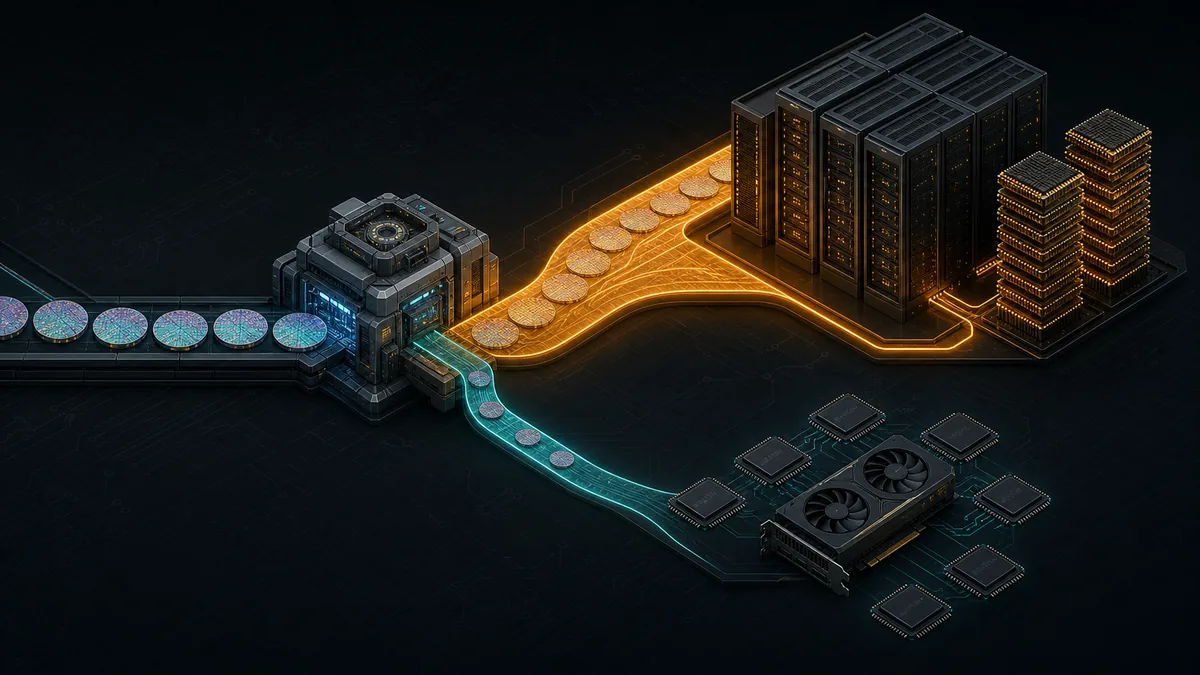
This needs one final qualification. Microsoft and Google are not literally taking the 32GB of GDDR7 that would have been soldered onto a particular gaming card. The path is indirect: hyperscalers expand AI infrastructure and long-term procurement; memory makers prioritize HBM, server DRAM, advanced nodes and cleanroom capacity; GDDR and other consumer products receive a lower allocation and weaker bargaining position; board makers and distributors then price in higher memory and replacement costs. The chain has several links, but TrendForce, Micron and the hyperscalers describe pieces that fit together.
Why Taiwan does not automatically get cheap cards
It is natural to ask why Taiwan pays so much when ASUS, MSI and Gigabyte are headquartered here. Headquarters location does not mean cards are reserved for the domestic market at cost. GPU and GDDR7 procurement serves global product lines. Completed boards are allocated according to market size, existing orders, distributor agreements and after-sales obligations.
Taiwan is an unusually sensitive window into PC supply-chain changes. It is not a special economic zone detached from global input prices.
Retailers also think about replacement cost, not only historical cost. Imagine a shop holding one card purchased under an older price schedule. If selling it means the next unit will cost more and arrive at an uncertain date, the shop values today’s inventory against what it will take to replace it. That does not prove every markup is justified. It explains why retail prices can move before the more expensive shipment physically reaches the shelf.
Trading-group psychology amplifies the move. Owners hold inventory after hearing about upstream increases. Used-card sellers anchor to visible retail listings. Buyers fear that waiting will cost more, and a small number of expensive transactions becomes the reference for the next round of asks.
This is why a screenshot is not a price index. The less transparent the transaction data, the easier it is to mistake the highest ask for a market consensus.
Who actually needs a 5090 at this price?
For somebody whose primary use is 4K gaming, “it might cost even more next month” is not a sufficient reason to chase this market. The RTX 5090 was never a value product. Once its price approaches the budget for an entire high-end PC, the right question is whether the incremental performance will materially change the experience you have.
If your current GPU already reaches acceptable image quality and frame rates, waiting is not missing an investment. It is declining to pay the risk premium attached to the most constrained part of the supply chain.
The calculation can be different for local AI, 3D rendering, video production or other workloads that genuinely use 32GB of VRAM. In that case, compare the card against the cost of not having it. Does insufficient VRAM prevent a billable job from running? What would equivalent cloud compute cost each month? How many work hours are lost to smaller batches or slower hardware?
If the machine shortens paid production work, NT$165,990 may still be defensible as a tool. The justification should be recoverable output, not a rumor that the next shipment will be worse.
Existing 5090 owners should not treat today’s retail listing as a brokerage balance. A used card has less warranty remaining, needs testing, and trades with a meaningful spread. A higher replacement cost means the card would be painful to replace if it failed or were sold; it does not mean I can convert mine into NT$165,990 without friction.
The real benefit of buying at NT$119,000 last November is not a theoretical 39.5% return. It is that I avoided having to choose between a work requirement and today’s extreme price.
Three signals matter more than guessing the peak
First, watch whether GDDR allocation actually improves. As long as memory makers prioritize server products and HBM, weak consumer demand does not guarantee immediate price relief.
Second, track whether the same board models stay in stock for several consecutive weeks. One discounted card is noise. Repeatable availability is evidence that supply has normalized.
Third, watch the gap between asking and transaction prices. When retailers hold inventory, high-priced cards in trading groups stop moving, and stores begin clearing stock with real discounts, pricing power has started to reverse.
The important lesson is not whether one label says NT$150,000, NT$165,990 or NT$200,000. It is that consumer hardware prices are now being shaped indirectly by data-center capital expenditure. A graphics card has not become a stock. Gamers have simply stopped being the highest-priority customers competing for upstream capacity.
I will keep tracking Taiwan’s purchasable prices, restock cadence and completed transactions. Unless a 5090 can repay its cost through professional work, my decision is straightforward: do not chase the flagship peak; spend the budget where it improves the whole system.
Data checked July 31, 2026. Sources: NVIDIA Marketplace — RTX 5090 price and 32GB GDDR7 specification, TrendForce — 2Q26 memory pricing and constrained GDDR allocation, Micron — June 24, 2026 investor presentation, Micron — July 9, 2026 US memory investment plan, Microsoft — FY2026 Q3 earnings call, Alphabet — 2025 Q4 earnings call, momo Taiwan — MSI RTX 5090 Gaming Trio OC listing, Tom’s Hardware — July 27, 2026 China RTX 50-series distributor price changes, Bank of Taiwan — July 2026 month-end USD/TWD rate.