Since AMD’s Zen 6 announcement in late July, Taiwanese build advice has split into two camps. One says AM5 runs through 2029, so build now and drop in a new CPU later. The other says wait for Ryzen 10000 and do it once, properly. Neither position is unreasonable, and both rest on the same unexamined assumption: that we already have a rough idea of what desktop Zen 6 will deliver, when, and for how much.
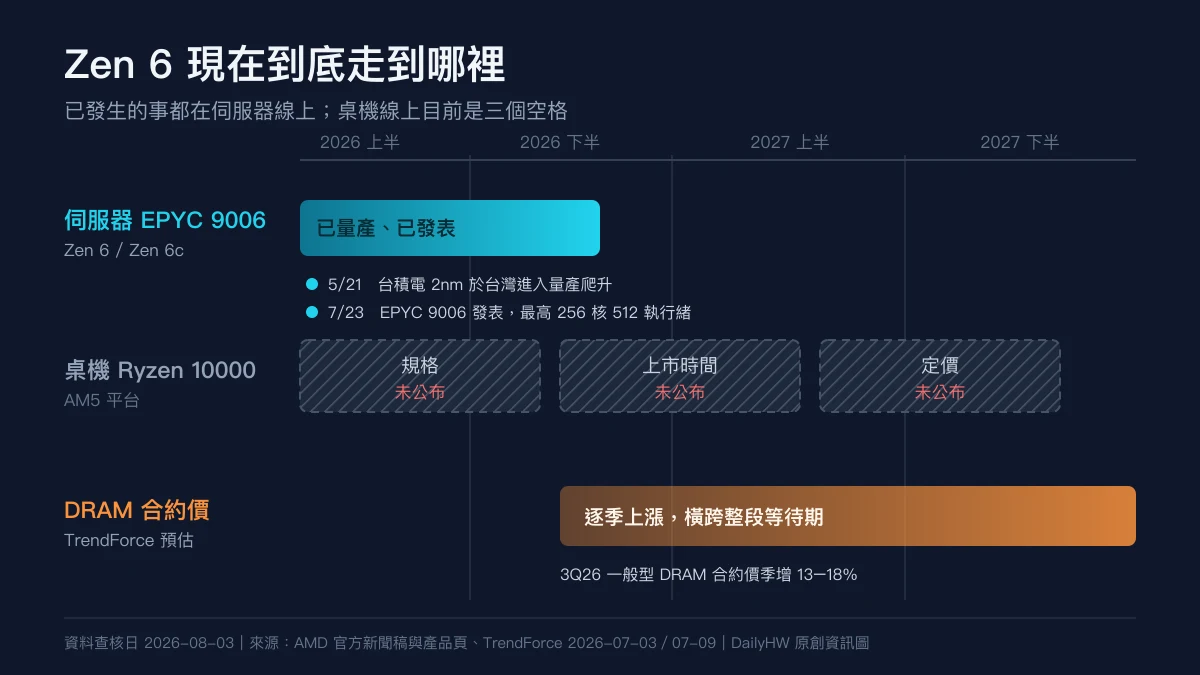
Having gone through AMD’s official material from May through July, my conclusion is that none of those three things has been announced. What AMD actually launched is the server-side EPYC 9006 family. Desktop Ryzen 10000 did not appear on a single slide. So “build now or wait” currently cannot be answered with performance at all. It can only be answered with the one number that is already moving: the price of memory.
What AMD actually announced
On May 21, 2026, AMD announced that its sixth-generation EPYC processor, codenamed “Venice,” had entered production ramp in Taiwan on TSMC’s 2nm process, with plans to also ramp at TSMC’s Arizona facility. AMD calls it the industry’s first high-performance computing product to enter production on that node. Lisa Su’s quote frames it as a step toward accelerating next-generation AI infrastructure. This is the most solid document in the whole timeline, because it describes a manufacturing fact rather than a roadmap.
Then came Advancing AI 2026 on July 22–23. AMD’s July 23 announcement introduced the EPYC 9006 Series in four variants: SP7 with up to 256 cores and 512 threads and boost clocks up to 5GHz; SP8 offering 8 to 128 cores in low-power designs; 9006X SP7 for HPC, with some variants reaching 5.15GHz and three times the L3 cache per core of SP7; and 9006 LP, formerly codenamed “Verano,” built around LPDDR memory as an AI host node. Platform specs include up to 16 channels of 12.8 GT/s MRDIMM support and PCIe Gen 6.
The architecture name only appears explicitly on AMD’s product page, which states that EPYC 9006 Series CPUs are “Built on ‘Zen’ 6 and ‘Zen’ 6c Core Architectures.” Zen 6 is AMD’s own naming — it is simply attached to server parts right now.
Here is the detail that quietly invalidates most of the downstream math: none of AMD’s official performance claims this generation is an IPC figure. The product page gives a rack-level comparison — within a 100kW rack power budget, EPYC 9996 delivers up to 3.3x the overall performance of NVIDIA Vera. The footnotes in the launch article benchmark against NVIDIA Vera and Intel Xeon, not against AMD’s own Zen 5. And starting with this generation, AMD has replaced its long-standing TDP reference with a new metric called Default CPU Power. When even the power figure changes definition, cross-generation number-matching deserves more care than usual.
“Up to 25–30% IPC” is a division, not a measurement
So where does the widely repeated 25–30% come from? It traces back to AMD’s November 2025 Financial Analyst Day, where AMD claimed Venice would deliver more than 1.7x the performance and efficiency of Zen 5 “Turin,” alongside more than 1.3x the thread density.
Put those together and the number falls out. Turin tops out at 192 cores, Venice at 256 — a 33% increase. 1.70 ÷ 1.33 ≈ 1.28. That division is the entire derivation behind “roughly 25–30% faster per core.”
The arithmetic is fine. Its assumption is not. For that result to describe per-core architecture, every gain beyond core count would have to come from the core itself. At least two large contributors say otherwise.
The memory subsystem. Turin runs 12 channels of DDR5-6400. Venice runs up to 16 channels of 12.8 GT/s MRDIMM — a third more channels, at roughly double the per-channel rate. On thread-saturated server throughput workloads, that is not a rounding error.
Clock speed. AMD explicitly cites boost clocks up to 5GHz, and 5.15GHz on HPC variants. That also sits inside the same 1.7x.
Both are exactly what a desktop platform does not inherit. AM5 is dual-channel DDR5 and will not become 16-channel because Zen 6 arrives. Desktop Ryzen already boosts above 5GHz, so there is no comparable headroom to recover. Taking a server figure apart and applying the remainder to a gaming PC may point in the right direction, but the number will almost certainly be wrong.
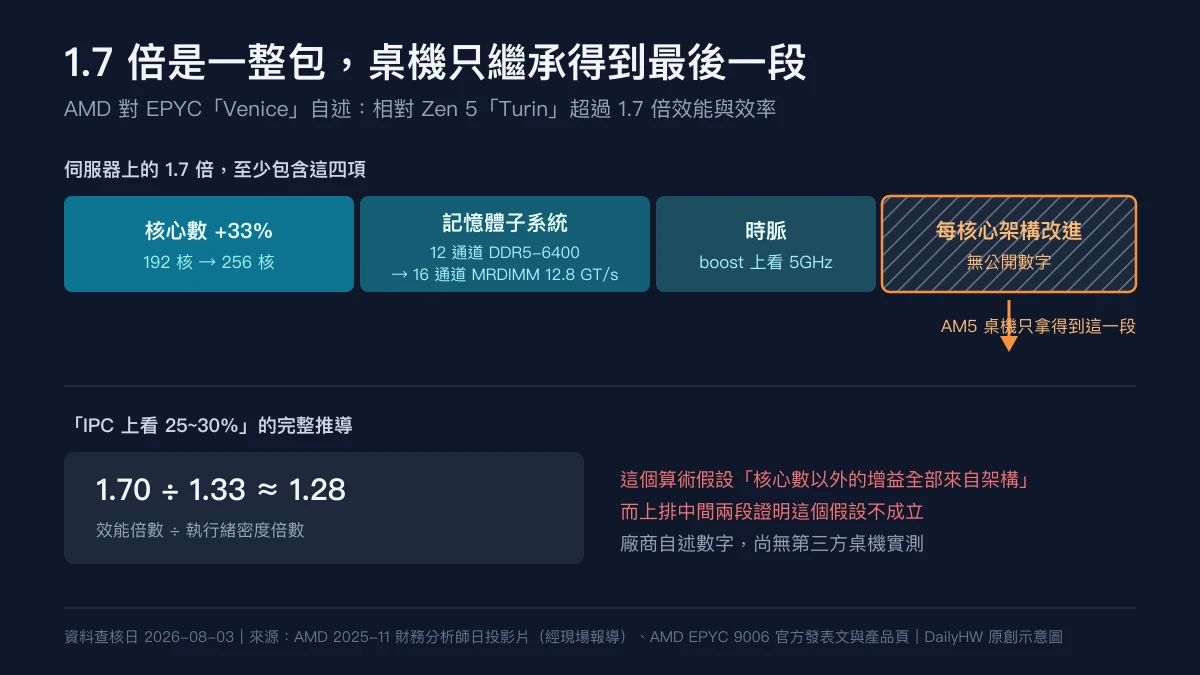
On evidence quality: 1.7x and 1.3x are vendor-stated figures. As of August 3, 2026 there is no third-party testing of any Zen 6 desktop processor, because no Zen 6 desktop processor exists. AMD has published nothing about desktop launch timing or pricing. Circulating claims about a 2027 launch, six-to-24-core configurations, or an NPU replacing the integrated GPU come from supply-chain leaks and press aggregation, not from AMD, and this article does not plan around them.
AM5 through 2029: what AMD promised, and what it did not
AM5 longevity is the most casually assumed part of this discussion, and it also rewards reading the original.
In its Computex 2026 blog dated May 31, 2026, AMD confirmed it is extending support for the Socket AM5 platform through 2029. In the same post, David McAfee, corporate vice president and general manager of AMD’s Client Channel and Graphics Business, framed the commitment around giving gamers the flexibility to upgrade over time. That post also launched the AM4 10th Anniversary Edition Ryzen 7 5800X3D at US$349 and the AM5 Ryzen 7 7700X3D at US$329.
What the post does not contain is just as important. It never names Zen 6. It never names Ryzen 10000. It does not list which chipsets qualify, and it says nothing about BIOS updates. It is a platform-level commitment, not a guarantee that the board on your desk will take the next CPU generation.
That distinction has bitten before — and the person who had to manage it was the same David McAfee. Speaking to Tom’s Hardware in January 2022, he laid out the whole problem: AM4 was constrained by a 16MB SPI ROM capacity limit, and as the supported CPU list grew, AMD “had to make some hard choices about what would fit in a particular 16MB SPI ROM footprint.” Ryzen 5000 initially shipped supporting only 500-series boards; 400-series support came after community backlash, and 300-series stayed off the table for years. Board vendors, meanwhile, resorted to de-featuring their BIOS implementations — discarding graphical interfaces for plain text menus — purely to fit a few more CPUs in.
That interview contains a second point worth remembering. Early 300-series boards differed from later AM4 boards in current delivery capability and other specifications, so dropping a flagship chip into one would not deliver “the performance the product is capable of.” McAfee’s framing was that the question is not whether the board is functionally capable, but whether you get the full performance.
For anyone currently on B650 or X670, the reasonable expectation is that AMD will honour 2029. Whether your board makes the list, whether it needs a flash first, whether anything disappears afterward, and whether its power delivery can actually feed a top-end next-gen part all depend on vendor support tables that have not been published yet.
What this costs in Taiwan
Now the money. Prices below are from Coolpc’s online quote sheet dated August 3, 2026, converted at the Bank of Taiwan cash selling rate of NT$32.72 per US dollar posted at 18:01 the same day. These are listed prices, not completed transactions; build bundles and cash discounts move the real figure.
| Item | Taiwan listed price | Approx. USD |
|---|---|---|
| ASUS PRIME B650M-F-CSM | NT$2,590 | US$79 |
| GIGABYTE B850M DS3H | NT$3,690 | US$113 |
| Crucial PRO 32GB (16GB×2) DDR5-6000 CL36 | NT$12,800 | US$391 |
| AMD Ryzen 7 9700X | NT$11,450 | US$350 |
| AMD Ryzen 7 9800X3D | NT$15,900 | US$486 |
This table is the whole argument. Reusing an existing board saves NT$2,590 to NT$3,690. A single 32GB DDR5 kit in the same machine costs NT$12,800 — three and a half to five times as much. On a long upgrade path, the motherboard was never the large line item. It is simply the one that is easiest to advertise.
And memory is still climbing. TrendForce’s July 3, 2026 outlook projects conventional DRAM contract prices rising 13–18% QoQ in 3Q26, noting that record contract prices have pushed PC and smartphone buyers toward their affordability limit, which is why increases are moderating rather than accelerating. Its July 9 report projects the same 13–18% QoQ range for server DRAM and states the duration explicitly: contract prices are expected to keep rising quarter over quarter from the second half of 2026 through the second half of 2027, with the pace easing.
Overlay those two facts and waiting becomes something you can price. If desktop Zen 6 does land in 2027, the entire wait falls inside the window TrendForce expects memory to keep appreciating.
Run the numbers against that NT$12,800 kit:
- A 20.2% increase adds NT$2,590 — exactly the price of an ASUS PRIME B650M-F-CSM.
- A 28.8% increase adds NT$3,690 — exactly the price of a GIGABYTE B850M DS3H.
In other words, memory needs to rise by less than a third for AM5 longevity to have saved you nothing. Against a forecast of 13–18% in a single quarter, that is not an aggressive assumption.
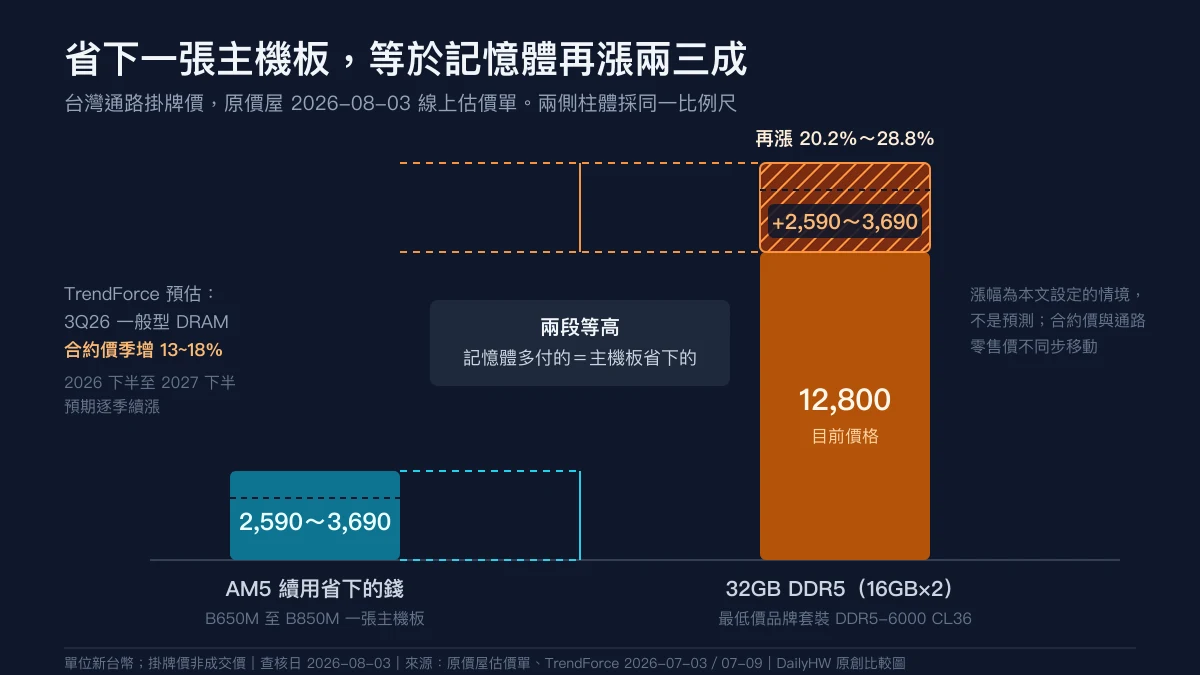
The limits of that calculation should be stated plainly. The 20.2% and 28.8% figures are scenarios I chose to size the effect, not forecasts. TrendForce publishes contract prices; retail shelf prices move differently, filtered through inventory, currency, channel margin and promotional timing. The point is not to predict where memory lands. It is to show how small the motherboard line is relative to everything else.
Three situations, three answers
Already on AM5 with DDR5 installed: wait. You are the genuine beneficiary of AMD’s longevity policy — memory pricing simply does not enter your next upgrade, which is a CPU swap and nothing else. Your only homework is to watch your board vendor’s support list and confirm the BIOS version when the time comes, rather than pre-worrying before that list exists.
Still on AM4 or an older Intel platform, with a machine that works: if you build now, the reason should be that memory is comparatively cheap today, not that Zen 6 is not worth waiting for. Conversely, if your system has another year in it, waiting is defensible — as long as you accept that what you save in performance regret, you may pay in memory.
Pure gaming, chasing maximum frame rates: the 9800X3D at NT$15,900 is a known quantity. Ryzen 10000’s gaming performance, launch date and price are three unknowns, and AMD’s desktop 3D V-Cache parts have historically arrived after the non-X3D models. Trading one known for three unknowns is speculation, not planning.
Four things I am watching
First, when AMD publishes desktop Zen 6 specifications and pricing — until then, every “Ryzen 10000 performance” claim is an estimate. Second, whether board vendors publish Zen 6 BIOS support lists and minimum ROM requirements for 600- and 800-series boards; that determines your board’s fate far more directly than AMD’s platform pledge. Third, whether TrendForce’s quarterly DRAM contract increases compress from double digits into single digits — that is the actual “safe to wait” signal. Fourth, independent third-party testing of desktop Zen 6 silicon; until it exists, 25–30% is the output of a division, not a measurement.
Zen 6 is real, it shipped, and the first wafers were made in Taiwan. But it went to the server room first. For desktop builders, the question worth asking this cycle is not how much faster the new architecture is. It is where your money goes while waiting for it — and right now that place is memory, not the CPU.
Data verified 2026-08-03. Sources: AMD — EPYC 9006 Series product page (Zen 6 / Zen 6c architecture and rack-level performance claims), AMD Newsroom — AAI 2026: 6th Gen EPYC server CPUs (2026-07-23), AMD — Venice production ramp on TSMC 2nm press release (2026-05-21), AMD — Computex 2026 blog: AM5 support extended through 2029 (2026-05-31), TrendForce — 3Q26 memory price outlook (2026-07-03), TrendForce — server DRAM contract prices and the upcycle through 2H27 (2026-07-09), ServeTheHome — AMD Financial Analyst Day: Venice 1.7x performance, 1.3x thread density (2025-11-11), Tom’s Hardware — David McAfee on Ryzen 5000 support for 300-series boards and the 16MB SPI ROM limit (2022-01-06), Coolpc — Taiwan channel listed prices, 2026-08-03 quote sheet, Bank of Taiwan — exchange rates, 2026-08-03.