Five days ago, while working through the AM5 upgrade math ahead of Zen 6, we recorded a specific number: a Crucial PRO 32GB (16GB×2) DDR5-6000 CL36 kit listed at NT$12,800 at CoolPC, one of Taiwan’s most-referenced DIY price sheets. Reopening the same quote sheet today, 8 August 2026, the same SKU lists at NT$14,599 — and CoolPC’s own change marker shows the previous price as exactly 12,800. Five days, 14.1%.
It is not an isolated SKU. On that same price sheet, the memory category carries 228 products, and 106 of them were flagged as price-changed that day — close to half.
Which brings up the question every DIY builder is asking in 2026: should you just wait for prices to fall? Our answer is that waiting is the wrong call this cycle — but not because “this time is different.” Quite the opposite. Memory remains a brutally cyclical industry, and this run will very likely correct too. The problem is that the two engines that historically drove those corrections have both stalled, and restarting them takes longer than most people are willing to wait.
Three different prices, constantly conflated
Most bad memory-price analysis comes from mixing up three things.
Spot prices are what DRAM chips trade for on the open market. That market is a small slice of total volume, it swings violently, and it produces the headline numbers. Contract prices are what manufacturers negotiate quarterly with large buyers — this is the one that actually determines what your memory module costs. Retail list prices are what you see at CoolPC or Newegg, several layers downstream of module makers, distributors, inventory and currency.
The distinction is not academic. A widely circulated claim has DDR5 spot prices up 7% in a single month and 448% year over year. We could not open the original reporting to verify those figures line by line — several syndicated pages returned 403 — and found no primary data to check them against, so this article does not cite them. What we can verify: TrendForce’s 3 July 2026 forecast puts conventional DRAM contract prices up 13% to 18% quarter over quarter in 3Q26, with NAND Flash up 10% to 15%.
The gap matters. Between a violent spot-market swing and your actual invoice sits the entire buffering capacity of the supply chain. Conversely, that less dramatic 13–18% is the number that genuinely lands on your bill.
The capacity exists — your DDR5 just isn’t first in line
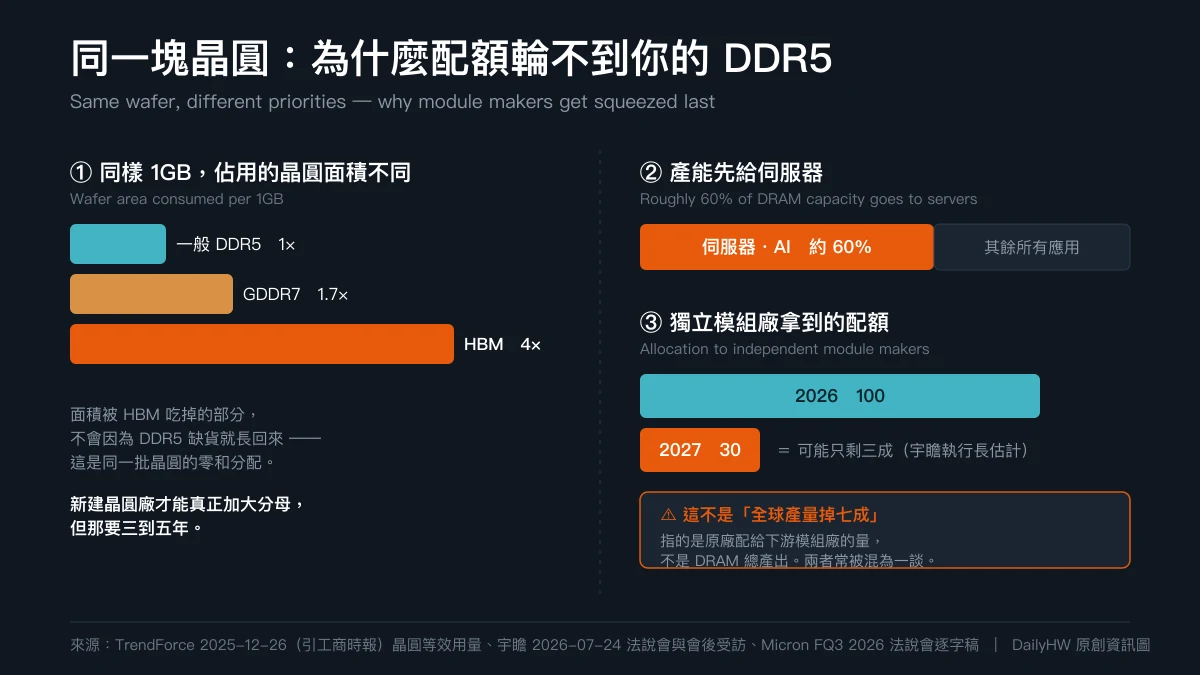
The key to this cycle is that the same wafer yields wildly different bit counts depending on what you build on it. By TrendForce’s December 2025 estimate (citing Commercial Times), each gigabyte of HBM consumes roughly 4× the capacity of conventional DRAM; GDDR7 runs about 1.7×. Shifting a line to HBM is not “making slightly less DDR5” — it is getting a quarter of the bits from the same wafer start.
Micron put this plainly in its fiscal Q3 2026 prepared remarks on 24 June 2026: technology transitions are driving slower bit growth over time, wafer growth needs are significantly increasing cleanroom and greenfield fab requirements, and “HBM’s growth and increasing trade ratio with every new generation further pressures non-HBM supply.” That is the manufacturer telling investors, not an analyst inferring.
Follow that chain downstream and you reach the part that matters most in Taiwan. Apacer CEO C.K. Chang said at the company’s 1H 2026 investor conference on 24 July 2026, and in interviews afterward, that the volume major manufacturers allocate to independent module makers could fall to just 30% of 2026 levels in 2027. He estimates roughly 60% of DRAM capacity now goes to server-related applications. His stated top risk is no longer overpaying — it is not getting supply at all. Apacer grew inventory to NT$12.4 billion by the end of the second quarter, up about 48% from NT$8.38 billion a quarter earlier, and arranged a five-year syndicated loan of up to NT$4 billion to buy chips whenever manufacturers release them.
One clarification worth making, because headlines routinely botch it: “module maker allocation down 70%” is not “global DRAM output down 70%.” The first is what manufacturers hand to downstream packagers; the second is total production. Conflating them badly distorts the sense of scale.
Both engines that used to bring prices down have stalled
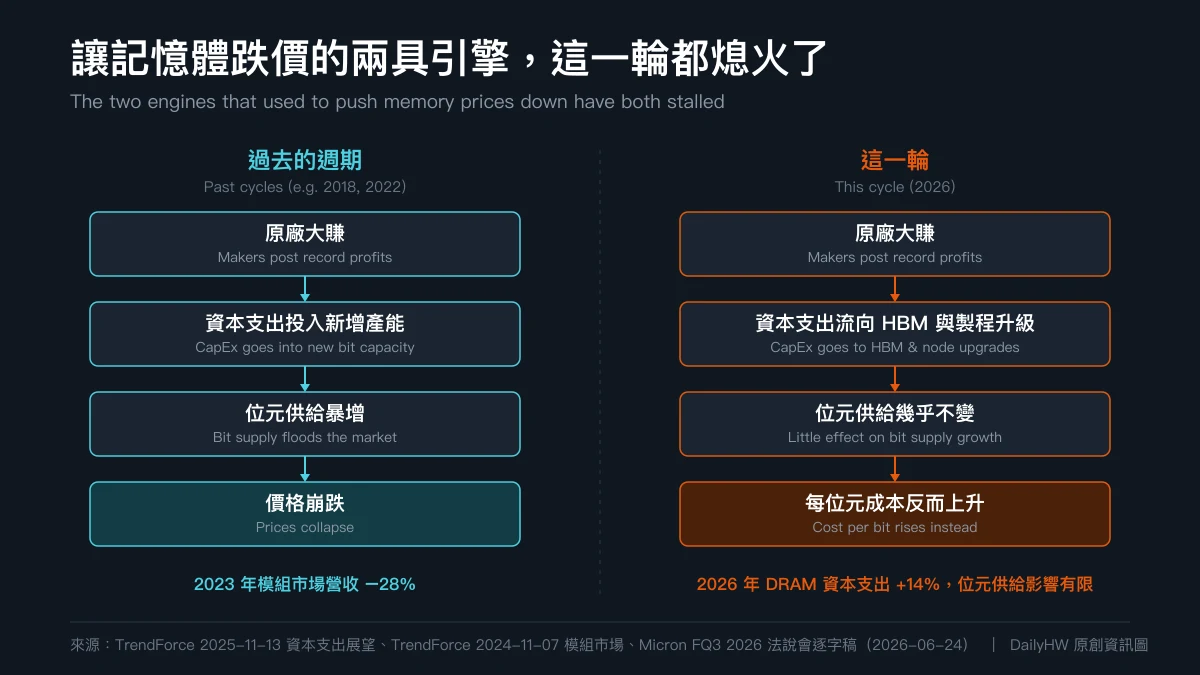
Historically, memory prices fell for two reasons.
Engine one: capacity expansion. Manufacturers get rich at the peak, pour it into new fabs, and two or three years later supply floods out and prices collapse. Capital spending is indeed rising this time — TrendForce’s November 2025 outlook has DRAM capex going from US$53.7 billion in 2025 to US$61.3 billion in 2026, roughly 14% growth. But the same report is explicit that the emphasis is “shifting from capacity expansion to advancements such as process technology upgrades, higher-layer stacking, hybrid bonding, and high-value products such as HBM,” and that this limited investment growth “is unlikely to significantly affect bit output.” The money arrived; the bits did not.
Engine two: falling cost. Each new node historically made every bit cheaper to manufacture, so prices drifted down over time even in balanced markets. This is the more consequential stall. In the same remarks, Micron warned that demand keeps skewing toward higher-performance, higher-value products whose complexity carries higher cost per bit — LP5 to LP6, DDR5 to DDR6, successive HBM generations — and that this, together with the ramp of significant greenfield capacity, “is projected to cause the blended DRAM cost per bit to rise from current levels.”
That sentence deserves more attention than it got. If manufacturing cost itself is rising, prices cannot return to old lows even when supply loosens. Supply and demand determine how far prices swing around the cost line; cost determines where that line sits. This cycle, the line is moving up.
As for when new capacity actually arrives, Micron gave dates: its first Idaho fab (ID1) is on track for first wafer output in mid-2027, the second (ID2) in late 2028. On the broader balance, the company said that even as it expects industry supply to improve gradually in 2028, it currently does “not have line of sight as to when memory supply will be able to catch up with increasing demand.”
But this cycle can still correct — and the signals are already showing
Stopping here would repeat the classic “this time is different” error. Honestly: memory has claimed uniqueness before and mean-reverted anyway. Global DRAM module market revenue fell to US$12.5 billion in 2023, down 28% year over year. The gravity of a cyclical industry has not been repealed.
Three cooling signals are already visible.
The rate of increase is decelerating. This only counts if you hold the metric constant, so: TrendForce’s conventional DRAM contract price rose approximately 93–98% QoQ in 1Q26, was forecast at 58–63% QoQ in 2Q26, and is forecast at 13–18% QoQ in 3Q26. Three points on one series — the deceleration is unambiguous.
(A caution about a figure that circulates widely: the “81% QoQ” often quoted for 1Q26 refers to overall memory industry revenue reaching US$97 billion, not to prices. Revenue and price are different metrics and cannot be compared in the same breath, which is why this article does not use that number.)
Consumers have hit an affordability ceiling. TrendForce’s 3 July report states outright that record contract prices mean customers in consumer markets such as PCs and smartphones “are reaching their affordability limit,” moderating 3Q26 increases. Apacer’s CEO likewise expects the rise to slow in 2H26 precisely because buyers find memory too expensive. Demand destruction is the oldest and most reliable counterweight there is.
The people warning of shortage have an interest in it. SK Hynix CEO Kwak Noh-jung told Reuters on 10 July 2026: “We forecast that next year will be the worst year in the industry’s history from the supply perspective,” adding that “customer demand will remain higher than our supply capacity even beyond 2030.” He said this on the day SK Hynix listed on Nasdaq. A memory maker forecasting prolonged scarcity is financially aligned with that forecast — which does not make it false, but does mean it should be cited with the conflict attached, not as neutral analysis.
The accurate formulation, then: this cycle will probably correct too, but the conditions for a 2023-style collapse — large greenfield capacity coming online, AI demand cooling, and cost per bit resuming its decline — are not one-for-one in place yet. The useful question is not “will it fall” but “how long can you wait.”
The Taiwan angle: no home-turf discount, and possibly no stock
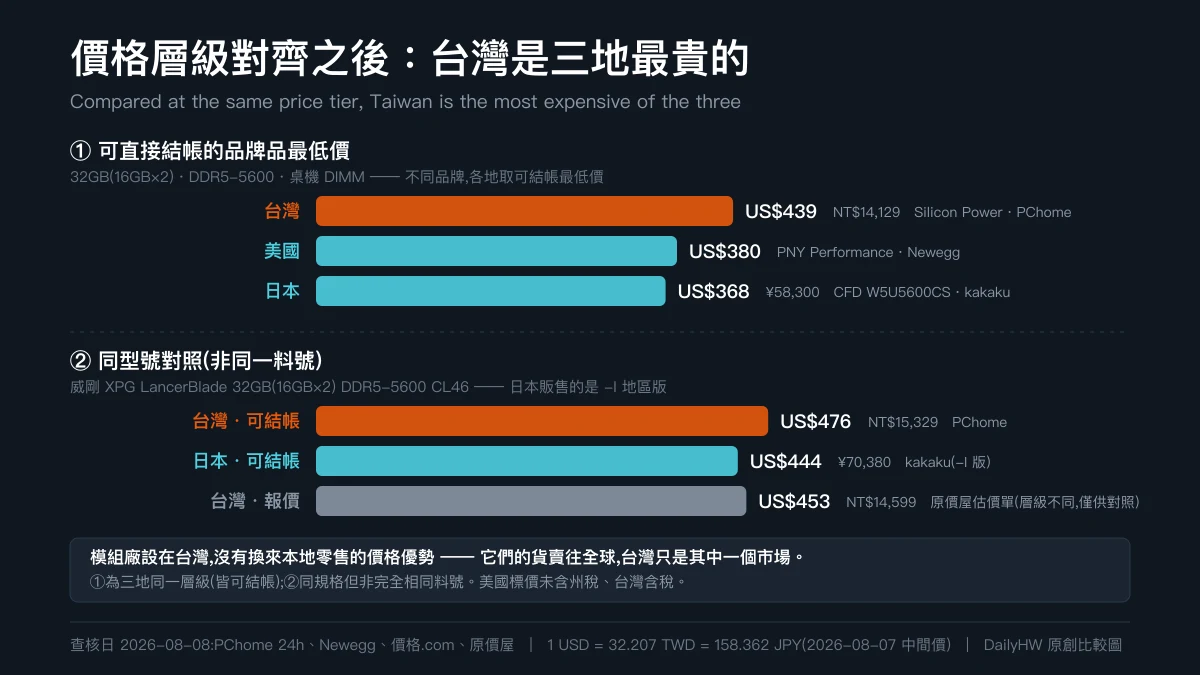
“The board and module makers are Taiwanese, so Taiwan should be cheaper” is a common assumption. Align the specifications and it simply does not hold.
The basis first, because this is where both specification drift and price-tier drift ruin comparisons. Below is a single band — 32GB (16GB×2), DDR5-5600, desktop DIMM — taking the cheapest branded price you can check out at directly in each market. Same tier everywhere, all checked on 8 August 2026.
| Market | Cheapest checkout price | Model | USD |
|---|---|---|---|
| Taiwan | NT$14,129 | Silicon Power XPOWER Zenith | ~US$439 |
| USA | US$379.99 | PNY Performance | US$380 |
| Japan | ¥58,300 | CFD W5U5600CS | ~US$368 |
Channels and full part numbers: Taiwan is SP032GXLWU560FDE on PChome 24h (orderable directly); the US figure is PNY MD32GK2D5560046-TB at Newegg; Japan is the lowest shop price on kakaku.com for CFD W5U5600CS-16G (click through and you buy from that shop). All three are prices a consumer can actually pay — none is a quote-sheet figure.
Taiwan is the most expensive of the three — roughly 15% above the US and 19% above Japan. (Including unbranded listings, PChome has a 32GB 16GB×2 kit at NT$12,900, about US$401, still above both.)
A cheapest-in-band comparison still spans different brands, so here is a same-model comparison — ADATA XPG LancerBlade (32GB = 16GB×2, DDR5-5600 CL46). One caveat first: these are not an identical part number. Japan sells the -I regional variant (AX5U5600C4616G-DTLABBK-I) against Taiwan’s AX5U5600C4616G-DTLABBK — same specification, different regional packaging and warranty.
| Channel | Price | Price tier | USD |
|---|---|---|---|
| Taiwan — PChome | NT$15,329 | checkout | ~US$476 |
Japan — kakaku.com (-I) |
¥70,380 | checkout | ~US$444 |
| Taiwan — CoolPC | NT$14,599 | quotation | ~US$453 |
Comparing like with like (the first two rows), Taiwan runs about 7% above Japan — the same direction as the cheapest-in-band result. One genuinely identical part number does exist, but only between the US and Japan: Crucial CT2K16G56C46U5 lists at US$499.00 on Newegg and ¥69,800 (~US$441) on kakaku.com. No Taiwanese channel carries that kit, so it cannot align all three markets.
List price, checkout price and transaction price are three different things
Those two Taiwanese prices are deliberately shown side by side, because they are not the same animal:
- A CoolPC quote sheet is a quotation — you still order or visit the store to complete the purchase, and the final figure can move.
- A PChome listing is a price you can check out at directly, which is the closest public proxy for what an ordinary buyer actually pays.
I measured three identical part numbers, and the gap ranged from 0% to 5%: the LancerBlade kit at NT$14,599 versus NT$15,329 (+5.0%), ADATA’s single 32GB stick AD5U560032G-S at NT$13,599 versus NT$14,279 (+5.0%), and Crucial’s CT16G56C46U5 16GB stick at NT$6,999 in both (0%).
Three samples are not enough to generalise into a rule, so no “add X percent” formula is offered here. What can be said is this: a quote-sheet number is not what you pay at checkout, the same part on the same day can differ by up to 5%, and you should know which of the two you are looking at when comparing. Every cross-border figure in this article uses checkout prices, precisely so that this tier gap does not leak into an international comparison.
Where Taiwanese prices currently sit (CoolPC list, 2026-08-08)
| Item | Range | Per GB |
|---|---|---|
| Single 16GB DDR5-5600 | NT$6,250 (KLEVV) – NT$7,500 (Kingston) | ~NT$391–469 |
| Single 32GB DDR5-5600 | NT$12,600 (UMAX) – NT$15,500 (Kingston) | ~NT$394–484 |
| 16GB kit (8GB×2) | NT$6,999 (UMAX) | ~NT$437 |
| 32GB kit (16GB×2) | NT$13,800 (ADATA CL36) – NT$16,000 (Kingston CL36) | ~NT$431–500 |
Note that the per-gigabyte price barely rewards buying larger: both 16GB and 32GB land in the NT$390–500 per GB band. The old rule that bigger modules dilute the unit price has stopped working this cycle — itself a signature of a shortage market.
The real risk is not price, it is position in the queue
ADATA, TeamGroup and Apacer are on the receiving end of allocation, not the negotiating end. They buy chips from SK Hynix and Samsung and package them into DIMMs; when manufacturers prioritise the AI and cloud customers who buy directly, how much reaches module makers is not theirs to decide. That also explains why “the module makers are Taiwanese” buys no local discount — their output goes worldwide, and Taiwan is just one market among many.
Translated into consumer terms, Apacer’s “biggest risk is not getting supply” means that over the next year, what changes at Taiwanese retailers may not be higher prices so much as a shorter list of things you can actually buy.
Taiwanese module makers did show real resilience through the last downturn: in the 2023 year that saw the global module market shrink 28%, TrendForce recorded ADATA holding third place worldwide on roughly flat revenue, while TeamGroup posted the strongest growth in the top ten and climbed three positions. They survived cheap memory. This time the test is not price — it is whether chips arrive at all.
Three situations, three answers
If you must build now: buy, and buy the capacity you actually need. For 2026 gaming and general productivity, 32GB is the sensible target. Do not jump to 64GB because “it will cost more later” — that spends today’s inflated prices on capacity you may not use for a year or two. If supply genuinely improves by 2028, that doubled outlay bought idle DIMM slots.
If you can wait: waiting is defensible, but know the bet. You are wagering on Micron’s 2028 rather than Apacer’s mid-2027, from a company that simultaneously says it has no line of sight on when supply catches up. Until then, quarterly contract prices are still forecast upward. Keeping your budget is fine if your machine is holding up; if you are stretching an already-struggling system for two more years purely to wait out prices, count those two years of daily experience as part of the cost.
If you have 16GB and want 32GB: the awkward one — and the answer depends entirely on a question you must settle first: is your 16GB one 16GB stick, or two 8GB sticks? The two situations call for opposite moves, so generic advice does not transfer.
- Currently 1×16GB (whether the board has two slots or four): you have the cheapest path available — add a second 16GB stick to reach 2×16. At CoolPC list prices a single 16GB DDR5-5600 starts at NT$6,250, less than half the cost of replacing everything with a 32GB kit (from NT$13,800). The risk is mixing: a different die revision is not guaranteed to hold rated speed and timings. Reduce it by buying the same brand, model and timings, then confirming EXPO/XMP applies stably on boot; failing that, run slightly slower manually — the performance loss is usually far smaller than the money saved.
- Currently 2×8GB with only two slots: your slots are full, and this is the one case where you genuinely must replace the lot with a 32GB kit (from NT$13,800), recovering a little by selling the 2×8GB. No other option exists.
- Currently 2×8GB with four slots: you can add another 2×8GB to reach 32GB, but go in with open eyes — populating all four slots loads the memory controller harder and tends to lose stability at higher speeds, and DDR5 8GB modules are poor value per gigabyte right now. Moving to 2×16GB is usually the cleaner outcome.
All three cases start with the same homework: check your motherboard’s QVL and the actual model of the modules you own, rather than guessing from capacity alone.
Four indicators worth tracking
Whether TrendForce’s quarterly contract-price increase keeps decelerating. The same metric has already braked twice (93–98% → 58–63% → 13–18%); a single-digit 4Q26 would be the first substantive “safe to wait” signal.
The share of memory SKUs flagged as price-changed on CoolPC’s quote sheet. Today it is 106 of 228. Back under 20–30% would suggest channel replacement costs have stabilised.
What Taiwanese module makers say about inventory and allocation on earnings calls. Apacer raising inventory 48% and taking a five-year loan to stockpile is an extreme defensive posture. When these companies start saying chips are easier to get, that will front-run any research-house forecast.
Whether manufacturer capex rotates back from HBM and node upgrades toward new bit capacity. Of the two stalled engines, that is the one more likely to restart first. Until it does, “waiting for prices to drop” is not waiting for a date — it is waiting for a condition that has not yet appeared.
Data verified 2026-08-08. Currency conversions use the 2026-08-07 mid-market rate of 1 USD = 32.207 TWD = 158.362 JPY (source below, directly openable; the Bank of Taiwan posted 32.215/32.365 spot buy/sell the same day, but that site applies an automated-access challenge and must be opened in a browser). All prices are as listed by each channel on the check date; quote-sheet and checkout prices are stated separately in the text.
Sources: Micron — Fiscal Q3 2026 earnings call prepared remarks (2026-06-24, PDF), TrendForce — 1Q26 conventional DRAM contract prices up 93–98% QoQ; industry revenue up 81% QoQ (2026-06-01), TrendForce — 3Q26 memory pricing outlook (2026-07-03), TrendForce — 2026 memory industry capex outlook (2025-11-13), TrendForce — DRAM module revenue fell 28% in 2023 (2024-11-07), TrendForce — AI to consume ~20% of global DRAM wafer capacity in 2026 (2025-12-26, citing Commercial Times), SK hynix — 2Q26 financial results (2026-07-29), Tom’s Hardware — SK Hynix CEO on 2027 supply and beyond 2030 (2026-07-11, citing Reuters), Tom’s Hardware — Apacer CEO on 2027 module-maker allocation (2026-07-29), CoolPC — Taiwan channel list prices, quote sheet of 2026-08-08, PChome 24h — cheapest Taiwan checkout price (Silicon Power SP032GXLWU560FDE), PChome 24h — Taiwan checkout price (ADATA AX5U5600C4616G-DTLABBK), Newegg — 32GB DDR5-5600 listings (checked 2026-08-08), kakaku.com — Japan 32GB (16GB×2) DDR5-5600 DIMM, cheapest first, kakaku.com — Japan single 32GB DDR5-5600 DIMM, cheapest first, currency-api — USD rates for 2026-08-07.