We have already covered how the RTX 5090 got to NT$165,990 in Taiwan. But almost nobody buys the halo card. The interesting question sits one or two tiers down, around the NT$30,000 mark: is the midrange being marked up the same way the flagship is?
The short answer is no — and the reason is not the GPU die. On 18 August 2026, the lowest listed price for an RTX 5070 at Coolpc was NT$28,888. The RTX 5060 Ti came in at NT$18,488 for the 8GB card and NT$24,490 for the 16GB card. (All three are the cheapest entry-level listings in their tier; their coolers and build quality are not comparable to each other.) Normalise all of them against NVIDIA’s own launch pricing and a pattern appears that the usual “GPUs are expensive again” coverage misses entirely: premiums sort by memory capacity, not cleanly by tier.
A note for readers outside Taiwan: Coolpc (原價屋) is a Taipei-based system builder whose public online quotation sheet lists live prices for essentially the entire DIY component market. It is the closest thing Taiwan has to a single reference price list, which makes it a useful — though single-retailer — snapshot.
The method, before the numbers
Cross-border price comparisons usually break on methodology, so here is the arithmetic in full. NVIDIA’s MSRP is a pre-tax USD figure; Taiwanese shelf prices include 5% VAT. You cannot simply divide one by the other. Every premium in this article uses one formula:
Premium = (lowest Coolpc listed price) ÷ (official MSRP × 31.91 × 1.05) − 1
The FX rate is the Bank of Taiwan’s posted USD spot selling rate of 31.91, quoted at 13:46 on 18 August 2026. MSRPs come from two NVIDIA press releases: the 6 January 2025 CES release ($1,999 for the RTX 5090, $999 for the 5080, $749 for the 5070 Ti, $549 for the 5070) and the 15 April 2025 release ($429 for the RTX 5060 Ti 16GB, $379 for the 8GB, $299 for the RTX 5060).
That converted figure is not an official Taiwanese price — NVIDIA has never published NTD MSRPs. It is simply a consistent ruler. And it is not an accusation of profiteering: the formula deducts nothing for freight, duties, the AIB partner’s cooling and power design, regional warranty, or retail margin.
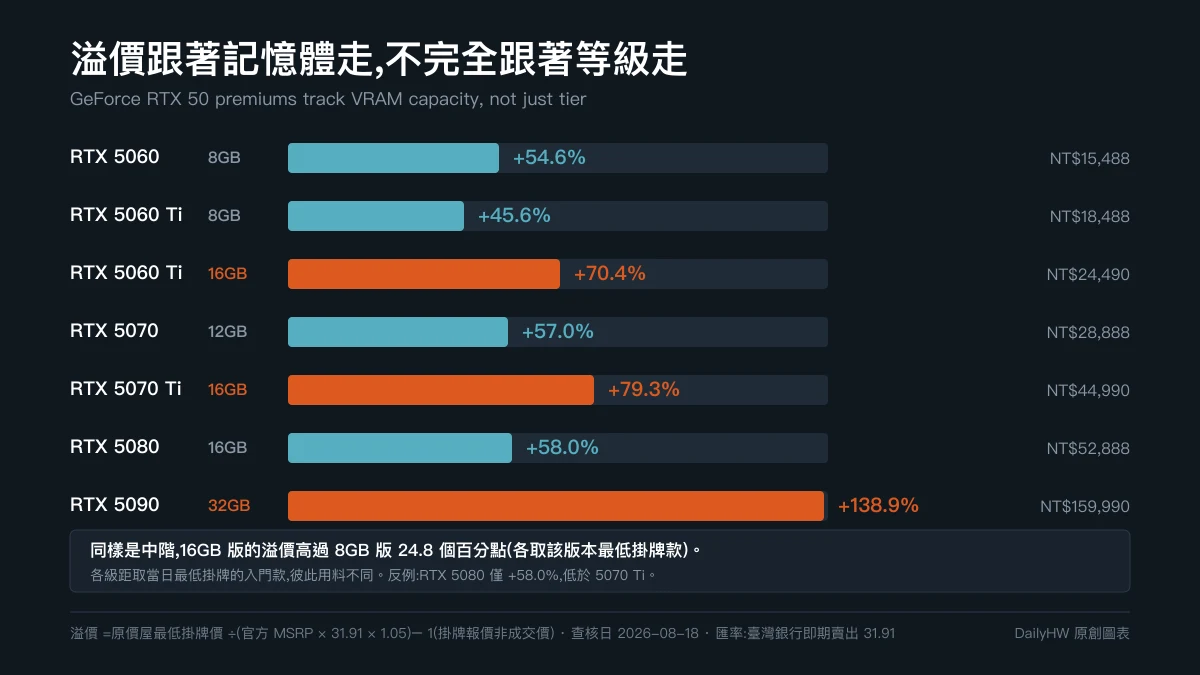
The results: RTX 5090 +138.9%, 5070 Ti +79.3%, 5060 Ti 16GB +70.4%, 5080 +58.0%, 5070 +57.0%, 5060 +54.6%, 5060 Ti 8GB +45.6%.
The flagship is still the worst offender, which surprises nobody. The surprise is inside the midrange: the two RTX 5060 Ti variants are 24.8 percentage points apart. (That compares the cheapest listing of each variant — two different models, not one card with more memory. The properly controlled comparison follows in the next section.)
Same GPU, NT$6,600 more for 8GB of memory
Per NVIDIA’s own specification page, both RTX 5060 Ti variants are identical on paper: the same 4,608 CUDA cores, the same 128-bit memory bus, the same GDDR7. The only difference is how much of that memory sits on the board. NVIDIA priced that difference at US$50 ($379 → $429), which converts to roughly NT$1,675 including VAT.
Working out what Taiwanese listings actually add for it takes some care. Subtracting the cheapest 8GB card from the cheapest 16GB card would be wrong — that folds in differences of brand, cooler design and warranty length. The clean comparison is same vendor, same product line, same clocks and cooling, 8GB against 16GB. The snapshot happens to contain six such pairs:
| Matched pair (identical spec) | 8GB | 16GB | Gap |
|---|---|---|---|
| ZOTAC Twin Edge OC (2602MHz / 22cm / dual-fan / 5yr) | 19,490 | 24,990 | 5,500 |
| MSI CYCLONE OC (2617MHz / 16cm / 5yr) | 18,990 | 25,590 | 6,600 |
| MSI SHADOW 2X OC PLUS (2617MHz / 23cm / dual-fan / 4yr) | 18,990 | 25,590 | 6,600 |
| MSI VENTUS 2X OC PLUS (2617MHz / 23cm / dual-fan / 4yr) | 19,590 | 25,990 | 6,400 |
| ASUS DUAL WHITE (2632MHz / 23cm / dual-fan / 4yr) | 19,990 | 26,590 | 6,600 |
| ASUS PRIME O (2647MHz / 31cm / triple-fan / 5yr) | 20,990 | 27,590 | 6,600 |
The gap runs from NT$5,500 to NT$6,600. Four of the six land on exactly 6,600, which is also the median — 3.9x the official price difference. Even the most conservative pair, the ZOTAC, still works out to 3.3x.
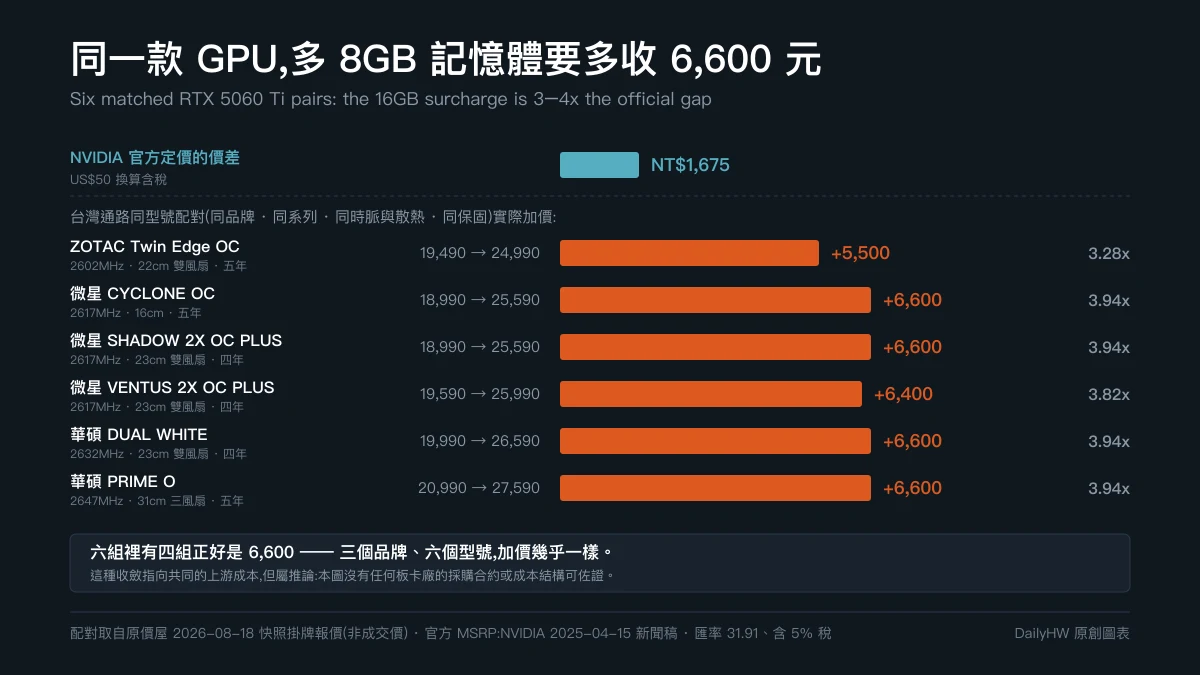
What deserves attention is how tightly those six numbers cluster. Three brands, six models, near-identical surcharges for the same 8GB of memory — four of them exactly equal. Independent pricing decisions rarely converge this neatly; the more economical explanation is that all six are pricing against the same upstream cost.
That is an inference, not a demonstrated cause: this article has no board partner’s purchase contract or cost structure to work from. Three things are established. The 16GB card carries twice the memory of the 8GB card (NVIDIA specification). GDDR7 supply remains tight (TrendForce). And high-capacity models are visibly scarcer in listings.
The supply side does line up. In the same snapshot, the 8GB RTX 5060 Ti had 24 listed SKUs; the 16GB version had 9. The RTX 5070 Ti had 10. The more memory a model carries, the less of it retailers list.
One widely repeated explanation deserves to be named and then set aside: tech media report that NVIDIA sells silicon and graphics memory to board partners bundled as a “GPU kit”, so memory increases flow straight into the cost of a finished board. It would explain the clustering neatly — but it carries no confirmation from NVIDIA either (the same category as the rumours discussed near the end of this article), so it stays a claim to be verified rather than a basis for inference.
The counter-example: by that logic, the 5080 should be worse
If capacity explained everything, the 16GB RTX 5080 should sit near the 16GB 5070 Ti. It does not. The 5080 lands at +58.0%, a full 21 points below the 5070 Ti — and below the 16GB 5060 Ti as well.
That counter-example matters, because it shows capacity is not the only variable. Two explanations are plausible: demand at the 5080’s absolute price point is thin enough that retailers cannot push further, or allocation cuts simply were not applied evenly across SKUs. Neither can be confirmed with the data in hand, so both stay flagged as open questions rather than conclusions.
There is a second, larger inversion worth stating plainly: GDDR7 demand is actually softening, and prices are not following it down. TrendForce reported on 3 July 2026 that “NVIDIA’s RTX PRO 6000 Blackwell has not generated the anticipated wave of GDDR7 demand, while weaker notebook shipments have also reduced demand for GDDR6 and GDDR7.” The same report notes suppliers continue to reallocate capacity flexibly toward other mainstream products, keeping graphics memory supply tight.
That is a sharper claim than “AI ate all the memory”. Consumer demand is not bidding prices up; supply is withdrawing faster than demand is falling. It also explains why the usual advice — wait for demand to cool and prices will drop — is not working in 2026. Our DDR5 pricing analysis shows the same mechanism from a different angle.
Gamers are not disliked — they are being diluted
Board partner financials show why midrange buyers have lost leverage. GIGABYTE’s Q1 2026 investor deck, dated 15 May 2026, breaks revenue down by product line on page 6:
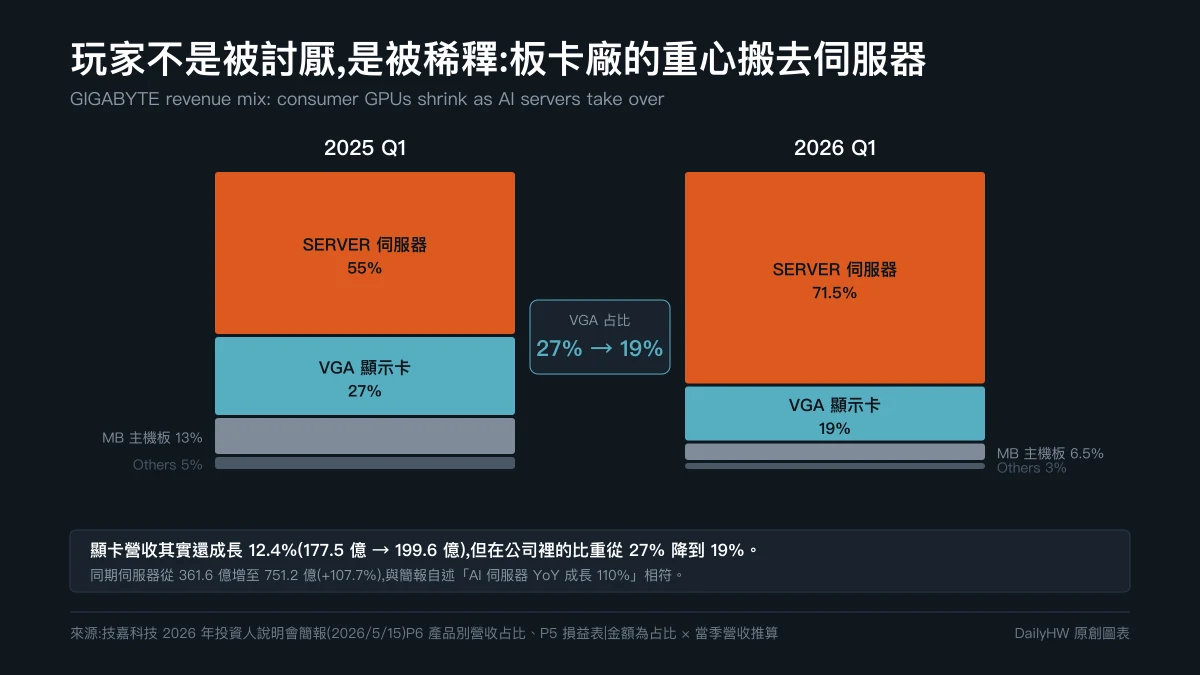
Q1 2025: servers 55%, graphics cards 27%, motherboards 13%, other 5%. Q1 2026: servers 71.5%, graphics cards 19%, motherboards 6.5%, other 3%.
One caveat prevents a common misreading: a shrinking share is not a shrinking business. Quarterly revenue rose from NT$65.747bn to NT$105.057bn (+59.78%), so graphics card revenue actually grew from roughly NT$17.75bn to NT$19.96bn — up 12.4%. Server revenue went from about NT$36.16bn to NT$75.12bn, or +107.7%, which lines up with the deck’s own claim of 110% YoY AI server growth and lets the two figures cross-check each other.
The accurate framing, then, is not that board partners abandoned gamers. It is that inside one Taiwanese manufacturer, consumer graphics fell from 27% to 19% of the business in a single year. When engineering attention, component allocation and capital all get divided between two lines, the smaller one negotiates from a weaker position. Worth noting alongside this: gross margin was 12.01%, below the 12.90% of Q1 2025 — revenue surged, margin did not.
Two things happening in Taiwanese retail
The same snapshot contains two details midrange buyers should register.
First, 9 of the 10 RTX 5090 listings are marked “system purchase only”, most with a “limited stock, please enquire” note attached. The flagship has been bundled into complete systems — a classic scarcity-era move to make a high-margin part pull whole builds along with it.
Second, desktop RTX 40 series cards have disappeared from Coolpc entirely. All 13 remaining 40-series listings are laptops with mobile RTX 4050 chips. If you want a 40-series desktop card now, the second-hand market is the only route.
The counterintuitive part: prebuilts undercut DIY
If flagships are bundled into systems, are those systems actually good value? We priced one out of the same snapshot: the Coolpc “烈空坐” build — R5 5500X3D / B550 / 16GB DDR4 / 1TB SSD / RTX 5060 Ti / case / 750W PSU — listed at NT$34,900.
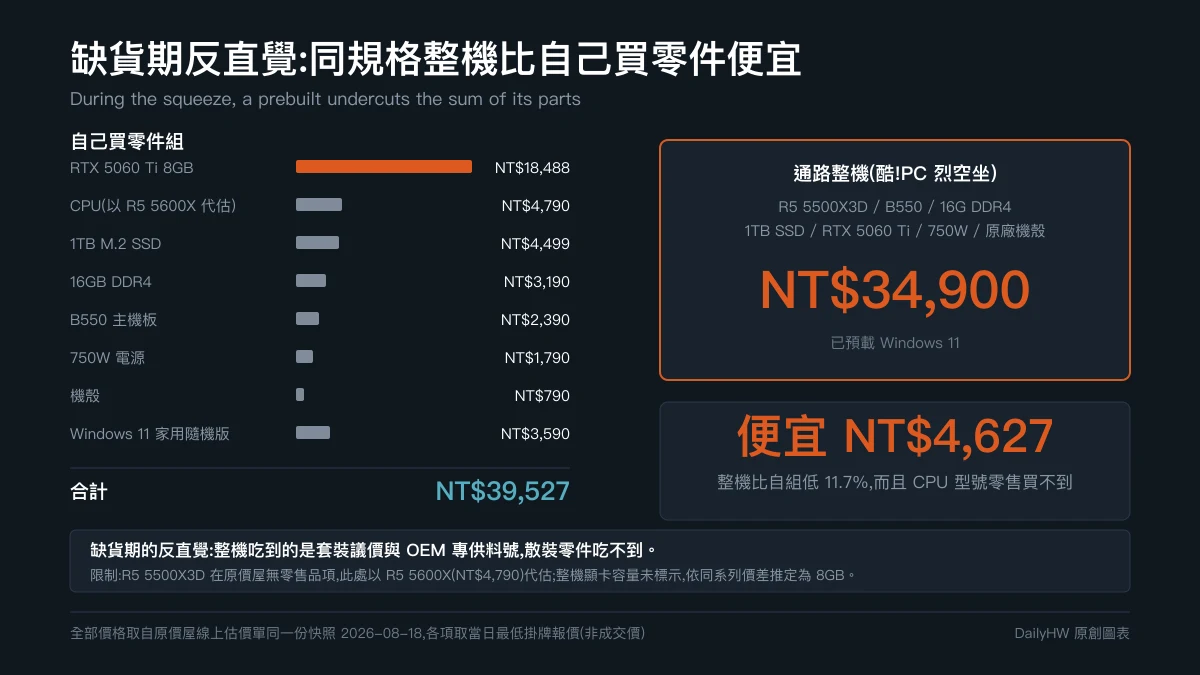
Adding up the cheapest equivalent parts that day: GPU 18,488 + 1TB SSD 4,499 + 16GB DDR4 3,190 + B550 board 2,390 + 750W PSU 1,790 + case 790, plus Windows 11 Home OEM at 3,590. The CPU is the awkward one — the R5 5500X3D has no retail listing at Coolpc at all, appearing only inside prebuilt specs, so we substituted the closest retail part, an R5 5600X at NT$4,790. Total: NT$39,527, or NT$4,627 (11.7%) more than the prebuilt.
Strip Windows out of the DIY column and the parts still cost NT$35,937 — about a thousand more than the complete system, which also ships with a CPU you cannot buy at retail.
Two limitations: Coolpc does not state which 5060 Ti variant is in that build, and we infer the 8GB version from pricing (the 5060 and 5060 Ti versions of the same build differ by NT$3,000, exactly the retail gap between those two cards) — an inference, not a listed spec. And prebuilt cases, PSUs and boards are rarely the parts a DIY builder would choose, which affects both upgrade headroom and resale value.
Used RTX 40 series: four conditions before you talk price
With no new desktop 40-series cards available, used is the only path. “It’s cheap” is not sufficient reasoning in 2026. Four conditions should all hold:
1. Know precisely what you lose. The 40 series does not lack DLSS 4. Per NVIDIA’s own DLSS compatibility table, RTX 40 supports Frame Generation, Ray Reconstruction, Super Resolution and DLAA. What is exclusive to the RTX 50 series is Multi Frame Generation (including the Dynamic variant). The real issue is not obsolescence — it is that the headline frame rates in marketing material are usually 50-series numbers with MFG enabled.
2. Warranty must be calculable. GPU warranties typically run from manufacture or first registration, not from resale. Even the newest 40-series cards are over a year old, so remaining coverage is often one to two years at best. If a seller cannot state the start date and registration status, price the card as if it has none.
3. The card’s history must be explainable. Multiple identical cards from one seller, mismatched wear, or a refusal to allow testing are all real risk signals. Ex-mining cards are not automatically disqualified — but that should be reflected in the price rather than concealed.
4. Compute the discount against a new card. A used 40-series card only makes sense at a large enough discount. Against a new RTX 5060 Ti 8GB at NT$18,488: if a used 40-series card costs more than about 70% of that, while carrying no warranty, no MFG, and one extra generation of age, the discount has not paid for the risk.
Used 40-series hardware is a conditional option, not a recommendation.
What we did not use, and why
This piece started from several widely circulated claims: that NVIDIA raised GPU kit prices to board partners by 20–30%, that RTX 50 production was cut 30–40% in the first half of 2026, and that global GPU prices rose roughly 15% over three months to July 2026.
For the record: those figures exist only in tech-media reporting, with no confirmation from NVIDIA, so this article does not build on them. Every pricing conclusion above rests on independently checkable primary sources — NVIDIA’s own press releases, Coolpc’s public quotation sheet, the Bank of Taiwan’s posted rates, and GIGABYTE’s investor deck.
The related claim that “the GDDR7 shortage will not resolve before the end of 2026” also needs correcting: per TrendForce, tightness stems from suppliers actively reallocating capacity, not from a demand surge. When it loosens is a capital allocation decision, not a technical deadline anyone can date in advance.
What to watch next
The 16GB-versus-8GB gap. Matched-pair surcharges for the 16GB version currently run NT$5,500–6,600 (median 6,600). Narrowing means GDDR7 allocation is genuinely easing; widening means capacity, not tier, becomes the decisive purchase variable.
SKU counts on high-capacity models. Nine listings for the 16GB 5060 Ti, ten for the 5070 Ti. Recovering SKU counts signal improving supply earlier than any single card’s price cut does.
Whether prebuilts stop undercutting parts. DIY becoming competitive again usually means component allocation has normalised.
Whether the RTX 5090 drops its “system purchase only” tag. The flagship returning to standalone sale is a direct sign channel inventory pressure has eased.
The practical call for midrange buyers: for 1080p–1440p gaming, the RTX 5060 Ti 8GB carries the lowest premium in this table (+45.6%). If you have a concrete VRAM-hungry workload — high-resolution textures, local AI models, video editing — that extra ~NT$6,600 buys years of headroom. If you are somewhere in between and just want the bigger number to be safe, this is the most expensive moment in recent memory to buy that particular insurance.
Data verified 18 August 2026. All prices are the lowest listed quotes in a single Coolpc snapshot. Coolpc’s sheet is an online quotation tool: the figures are listed reference prices, not transaction prices — what a buyer actually pays varies with negotiation, bundle deals and stock. Sources: NVIDIA — RTX 50 series launch release, 6 Jan 2025 (5090/5080/5070 Ti/5070 MSRP), NVIDIA — RTX 5060 family release, 15 Apr 2025 (5060 Ti/5060 MSRP), NVIDIA — DLSS technology page, generation compatibility table, NVIDIA — RTX 5070 family specifications (12GB / 16GB GDDR7), NVIDIA — RTX 5060 family specifications (both 5060 Ti variants: 4,608 CUDA cores / 128-bit), GIGABYTE — Q1 2026 investor conference deck, 15 May 2026, TrendForce — memory pricing and GDDR supply, 3 Jul 2026, TrendForce — server DRAM contract prices and LTAs, 9 Jul 2026, Coolpc — online quotation sheet, Bank of Taiwan — posted FX rates (USD spot selling 31.91, 18 Aug 2026 13:46).