The short answer first. On 24 August 2026, a balanced 1440p gaming build from CoolPC’s online configurator adds up to NT$69,597 — about US$2,181 at the Bank of Taiwan spot selling rate of 31.915. Swap the RTX 5070 for AMD’s RX 9070 XT and the total drops to NT$67,599 while gaining roughly 20% in performance, going by TechPowerUp’s aggregate numbers. A 16GB-VRAM budget tier lands at NT$50,909, and an X3D-plus-5070-Ti tier at NT$96,449.
The more interesting question is what this machine cost a year ago — and for once there is a clean, first-hand answer. The Internet Archive holds a snapshot of the very same CoolPC price list from 20 August 2025. Match it SKU for SKU against today’s list and you get a controlled experiment: same retailer, same page, same part numbers, twelve months apart. Eight identical SKUs that added up to NT$45,578 last August now add up to NT$70,990 — NT$25,412 more, a 55.8% jump. Almost all of it comes from three components; the other five, combined, actually got cheaper.
Methodology and caveats up front. All Taiwan prices in this article are listed prices from CoolPC’s online configurator (snapshot taken 24 August 2026; the 2025 figures come from the Internet Archive capture of the same page dated 20 August 2025). CoolPC is Taiwan’s best-known DIY PC retailer, and its configurator is the country’s de facto public price board — but these are tax-included listed prices, not final transaction prices; haggling and bundle discounts exist, and most GPU listings carry small bundle rebates of NT$90–500 that I ignore throughout. USD conversions use the Bank of Taiwan USD spot selling rate of 31.915 from the closing board of 24 August 2026 (posted 16:01), taken from the bank’s retrievable historical-rate page.
Pin down the target before the parts
“1440p gaming PC” gets thrown around loosely, so here is the assumption behind every choice below: 2560×1440 at high (not maxed) settings, 60fps+ in demanding AAA titles, and 144Hz-class frame rates in esports games, on a machine that is primarily for gaming with some general desktop work. If you mainly play League-style esports titles, this list is overkill; if you want 4K or heavy content creation, it is not enough.
| Part | Pick | Listed price | Why |
|---|---|---|---|
| CPU | AMD Ryzen 5 9600X | NT$7,950 | Six Zen 5 cores are not the bottleneck at 1440p; NT$600 off when bundled with a board |
| Motherboard | ASUS B850M AYW GAMING WIFI | NT$3,990 | Same SKU is NT$1,000 cheaper than last year; 2.5G LAN and Wi-Fi included |
| Memory | G.Skill Trident Z5 RGB 32GB (16GB×2) DDR5-6000 CL30 | NT$14,500 | 32GB is the sweet spot; 6000 CL30 is the stock answer for AM5 |
| SSD | ZhiTai TiPlus7100s 2TB (TLC) | NT$8,899 | NT$900 over its QLC sibling buys 50% more rated endurance |
| GPU | INNO3D RTX 5070 12GB TWIN X2 | NT$28,888 | Cheapest listing in its tier; see the AMD alternative below |
| PSU | COUGAR GR 750W Gold, ATX 3.1 | NT$2,590 | Flat year over year; NVIDIA’s official guidance for the 5070 is 650W, so this has headroom |
| Case | Montech XR | NT$1,590 | Flat year over year |
| Cooler | Thermalright Peerless Assassin 120 V3 | NT$1,190 | Overkill for a 65W chip, but it costs NT$1,190 |
| Total | NT$69,597 | ≈ US$2,181; OS and monitor not included |
Three swaps people will ask about:
The AMD card — this year’s most serious alternative. Gigabyte’s RX 9070 XT GAMING 16G lists at NT$26,890 with a five-year warranty (PowerColor’s version goes as low as NT$25,590, but with three years). On TechPowerUp’s aggregate relative-performance index the RX 9070 XT runs about 23% faster than the RTX 5070, carries 16GB of GDDR6 against the 5070’s 12GB of GDDR7, and costs about 7% less. The trade-off is ecosystem: DLSS 4 multi-frame generation and broader game support remain NVIDIA’s home turf, and CUDA workloads leave you no choice at all. For pure gaming, the 9070 XT is the highest performance-per-dollar card on this page.
An X3D CPU? The R7 9800X3D lists at NT$15,900 — double the 9600X. At 1440p the GPU is the bottleneck in most titles; X3D pays off in high-refresh esports and simulation-heavy games. Spending that NT$8,000 gap on upgrading the 5070 to a 9070 XT instead is the smarter move for most buyers.
64GB of RAM? No. As we argued in the DDR5 surge analysis, buying capacity you won’t use for one to two years at record-high unit prices doubles your downside. For gaming, 32GB is the answer.
What the same parts cost a year ago
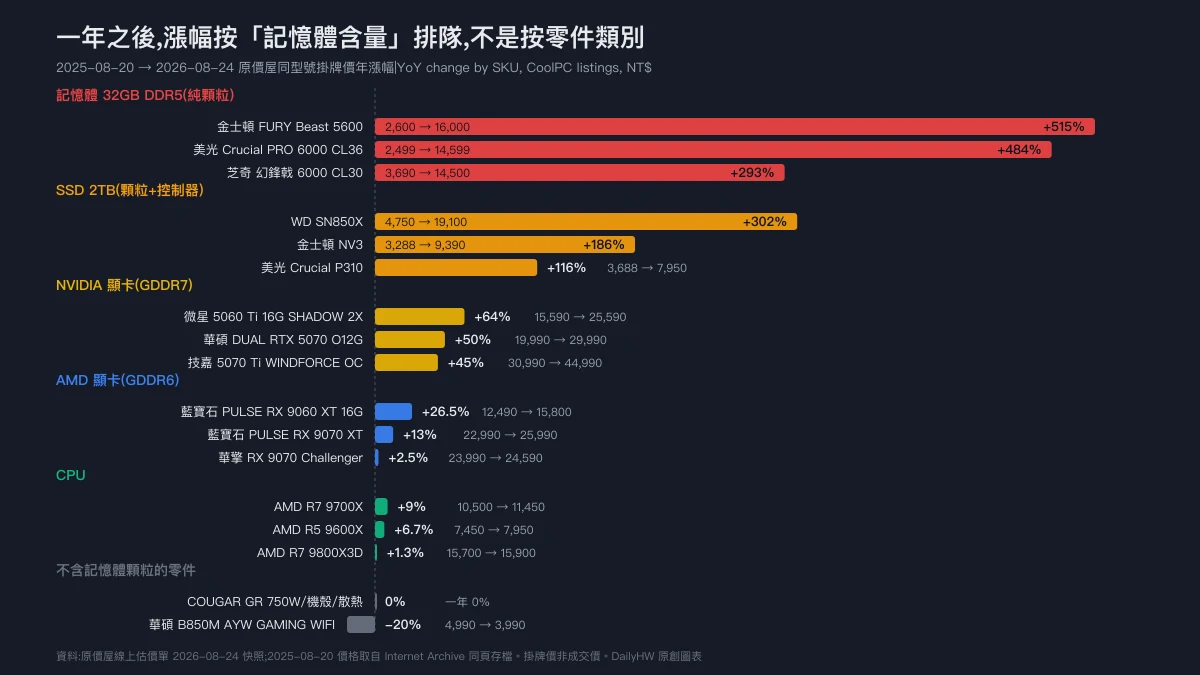
Pair up every SKU that appears, character for character, in both snapshots, and the distribution of increases looks like this:
| Same SKU | 2025-08-20 | 2026-08-24 | Change |
|---|---|---|---|
| Kingston FURY Beast 32GB DDR5-5600 | NT$2,600 | NT$16,000 | +515% |
| Micron Crucial PRO 32GB DDR5-6000 CL36 | NT$2,499 | NT$14,599 | +484% |
| G.Skill Trident Z5 RGB 32GB DDR5-6000 CL30 | NT$3,690 | NT$14,500 | +293% |
| WD Black SN850X 2TB | NT$4,750 | NT$19,100 | +302% |
| Kingston NV3 2TB | NT$3,288 | NT$9,390 | +186% |
| Micron Crucial P310 2TB | NT$3,688 | NT$7,950 | +116% |
| MSI RTX 5060 Ti 16G SHADOW 2X OC PLUS | NT$15,590 | NT$25,590 | +64% |
| ASUS DUAL RTX 5070 O12G | NT$19,990 | NT$29,990 | +50% |
| Gigabyte RTX 5070 Ti WINDFORCE OC SFF | NT$30,990 | NT$44,990 | +45% |
| Gigabyte RTX 5070 WINDFORCE OC SFF | NT$20,990 | NT$29,990 | +43% |
| Sapphire PULSE RX 9060 XT 16GB | NT$12,490 | NT$15,800 | +26.5% |
| Sapphire PULSE RX 9070 XT | NT$22,990 | NT$25,990 | +13.0% |
| ASRock RX 9070 Challenger 16GB | NT$23,990 | NT$24,590 | +2.5% |
| AMD Ryzen 7 9700X | NT$10,500 | NT$11,450 | +9.0% |
| AMD Ryzen 5 9600X | NT$7,450 | NT$7,950 | +6.7% |
| AMD Ryzen 7 9800X3D | NT$15,700 | NT$15,900 | +1.3% |
| COUGAR GR 750W / Montech XR / Thermalright BA120 | — | — | all 0% |
| ASUS B850M AYW GAMING WIFI | NT$4,990 | NT$3,990 | −20% |
Three things in this table deserve a pause.
First, the increases sort by memory content, not by product category. DDR5 modules are almost pure memory dies: up 293–515%. SSDs are dies plus a controller: up 116–302%. Graphics cards are dies plus a GPU plus an entire board: up 2.5–64%. Parts with no memory dies at all — PSU, case, cooler — moved exactly 0%. That gradient matches the upstream mechanics we tracked in the DDR5 analysis and the NAND shortage piece: TrendForce forecasts conventional DRAM contract prices up another 13–18% and NAND Flash up 10–15% in 3Q26. The price shock starts at the die.
Second, NVIDIA and AMD cards inflated at different orders of magnitude. RTX 50 SKUs rose 35–64% year over year; RX 9000 SKUs, which use GDDR6, rose 2.5–26.5%. Our RTX 5070 premium analysis showed that within NVIDIA’s lineup, memory capacity — not GPU tier — now drives Taiwan’s retail premiums. The year-over-year view confirms the same story on the time axis: what got expensive is not the graphics card, it is the memory soldered onto it. It also explains this year’s odd inversion — the 9070 XT delivering more performance for less money — because it draws on GDDR6 capacity that AI demand has not yet cannibalized.
Third, CPUs and motherboards sat this one out. Three Ryzen chips moved +1.3% to +9%, and the B850 board actually fell 20%. If your plan includes a platform upgrade, that half of the bill is friendlier than last year. Only three line items are doing all the damage.
The whole-build audit: where NT$25,412 went
Build one machine from the eight parts that exist as identical SKUs in both snapshots (Kingston NV3 2TB as the SSD, Gigabyte’s RTX 5070 WINDFORCE OC SFF as the GPU, the rest as in the table above):
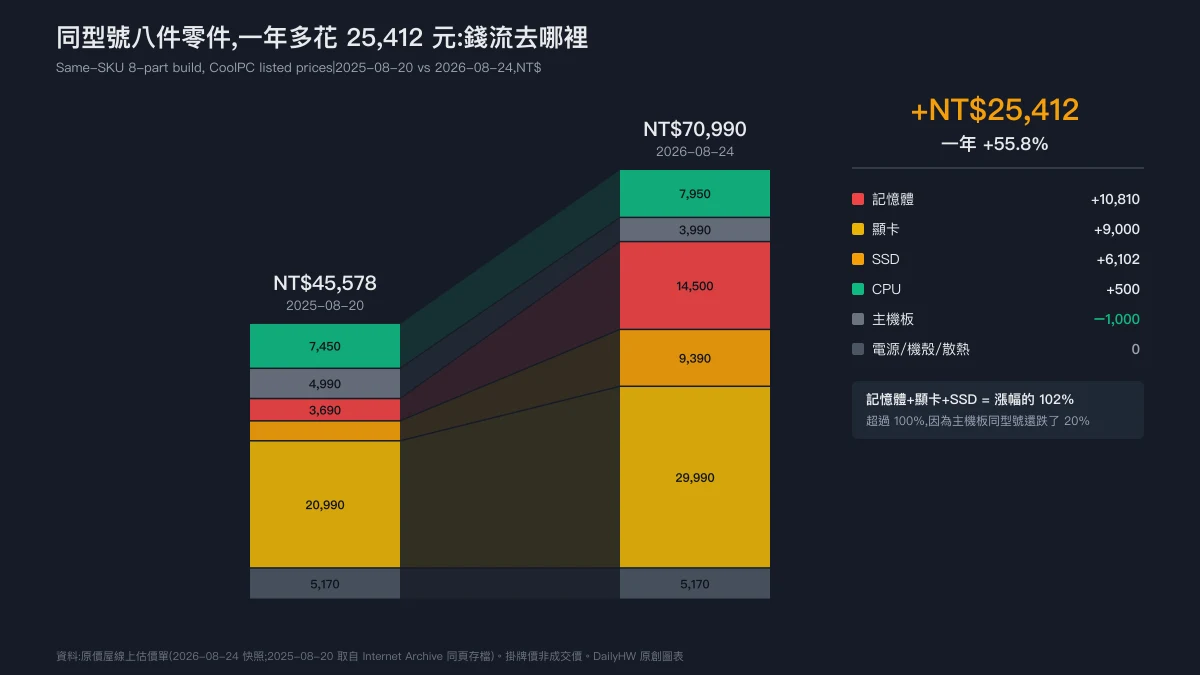
- 2025-08-20 total: NT$45,578 (≈ US$1,428)
- 2026-08-24 total: NT$70,990 (≈ US$2,224)
- Delta: +NT$25,412 (+55.8%)
Break the delta apart: memory +10,810, GPU +9,000, SSD +6,102 — together +25,912, or 102% of the entire increase. It exceeds 100% because the motherboard contributed −1,000, the CPU just +500, and the PSU, case and cooler zero. “PCs got expensive” is imprecise. The precise statement is: memory, graphics cards and SSDs got expensive, hard enough to drag a whole machine up by half.
One honesty note: this audit build exists for SKU-level comparability and is not identical to the recommended list above (which picks better-value 2026 parts for memory, SSD and GPU). And NT$45,578 was only real if you actually bought that exact combination last August — it is a benchmark, not “the best 2025 build”. Both snapshots are listed prices; bundle and haggling room may differ across years, so ignore single-digit differences. The 55.8% magnitude is not something haggling can erase.
Three budget tiers, and the trade each one makes
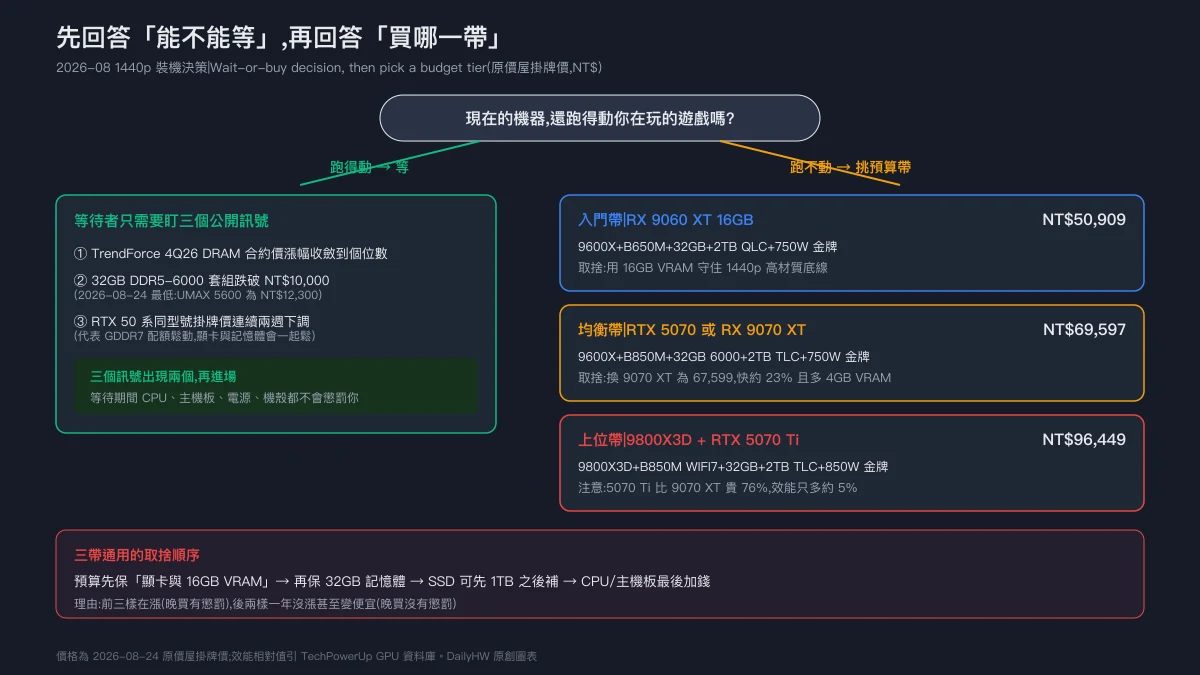
NT$50,909 entry tier (≈ US$1,595): 9600X at the bundle price (7,350) + Gigabyte B650M H (2,990) + UMAX 32GB DDR5-5600 (12,300) + ZhiTai Ti600 2TB QLC (7,999) + Sapphire PULSE RX 9060 XT 16GB (15,800) + Apexgaming GTR-750MW Gold (2,490) + a NT$990 case + Thermalright Burst Assassin 120 (990). The defining call here is holding the 16GB VRAM line with the RX 9060 XT so 1440p high-texture settings don’t die on capacity first. The QLC trade-off is one we quantified in the NAND piece: for gaming and general use, 800TBW of rated endurance is not the real-world constraint.
NT$69,597 balanced tier (≈ US$2,181): the main list above; NT$67,599 in its RX 9070 XT variant.
NT$96,449 upper tier (≈ US$3,022): 9800X3D (15,900) + ASUS TUF B850M-PLUS WIFI7 (6,490) + the same 32GB kit (14,500) + TiPlus7100s 2TB (8,899) + Gigabyte RTX 5070 Ti WINDFORCE OC SFF (44,990) + COUGAR GR 850W (2,890) + Montech XR (1,590) + PA120 V3 (1,190). Be honest with yourself here: the 5070 Ti is among the fastest-inflating SKUs on the table (+45% YoY), and by TechPowerUp’s aggregate index it leads the 9070 XT by only about 5% while costing 76% more. The defensible reasons to buy this tier are DLSS 4 multi-frame generation, CUDA, or the 16GB of GDDR7 — not “the budget allows it”.
Across all tiers, the ordering logic is the same: spend first on the GPU and 16GB of VRAM, then on 32GB of RAM; the SSD can start at 1TB and grow later; the CPU and motherboard are the last places to add money — because the first three are inflating (waiting is punished) and the last two are flat or falling (waiting is free).
The honest section: three kinds of people who should not buy now
People whose current PC still runs their games. Every quarter you wait, the CPU, board, case and PSU will not punish you; only memory, SSD and GPU can. And all three sit at the top of a year-long surge — the same 32GB DDR5 SKUs are up roughly four- to six-fold — while the momentum visibly cools: on 8 August, CoolPC’s memory category had 106 of 228 listings flagged with price changes (documented in our DDR5 analysis); in the 24 August snapshot of the same page, the price-change flags dropped to zero and the category shrank to 215 listings. The channel signal reads “no longer marking up — but shelves thinning”. TrendForce’s 3Q26 contract-price forecast has likewise moderated to 13–18% after two quarters of far steeper gains. None of this proves prices fall tomorrow, but the “buy today or pay more tomorrow” engine is losing steam. If you can wait, wait.
People stockpiling out of fear. Memory and SSDs are the parts with the steepest increases this cycle. Buying maximum capacity at peak unit prices is how you maximize cycle risk. Buy exactly what you need, or nothing.
People who actually play at 1080p. Esports titles at 1080p ask at least a tier less of the GPU and memory than 1440p AAA does; this list is NT$20,000+ of over-provisioning for you. Step the GPU and SSD down a tier and price it again — that is your starting point.
As for when to come back, don’t guess — watch three publicly checkable signals: (1) TrendForce’s 4Q26 DRAM contract-price growth converging to single digits; (2) a 32GB DDR5-6000 kit listing below NT$10,000 on CoolPC (today’s floor: NT$12,300 for a 5600 kit); (3) RTX 50 SKUs logging two consecutive weeks of price cuts — that last one would mean GDDR7 allocation is loosening, which frees GPUs and DRAM together. Two of the three showing up marks the start of a return to normal; until then, these prices are the reality you plan around.
Shelf life
Every price in this article will expire. Two things should not, at least for several quarters: the inflation concentrates in parts that carry memory dies, and AMD’s GDDR6-based cards are the price shelter of the GDDR7 era. As long as both hold, the ordering logic — VRAM first, capacity later, platform whenever — holds with them. We will update this list when prices move by magnitudes, with the revision date noted up top.
Data and verification date: 2026-08-24. All Taiwan prices are listed (tax-included) prices from CoolPC’s online configurator — reference quotes, not final transaction prices; bundle rebates of NT$90–500 on most GPU listings are excluded. 2025 prices come from the Internet Archive capture of the same page dated 2025-08-20. USD figures use the Bank of Taiwan USD spot selling rate of 31.915 from the 2026-08-24 closing board (posted 16:01), retrievable from the bank’s historical-rate page. GPU performance comparisons cite TechPowerUp’s aggregate relative-performance index, not single-game benchmarks.
Sources: CoolPC — online configurator (checked 2026-08-24), Internet Archive — CoolPC configurator capture, 2025-08-20, Bank of Taiwan — historical closing rates for 2026-08-24 (USD spot selling 31.915, posted 16:01), TrendForce — 3Q26 memory price outlook: DRAM contract prices +13–18% QoQ, NAND +10–15% (2026-07-03), TechPowerUp — Radeon RX 9070 XT specs and relative performance, NVIDIA — GeForce RTX 5070 family official specs (12GB GDDR7).