Apple announced the iPhone 18 Pro and iPhone 18 Pro Max on September 9 in the US, which was September 10 in Taiwan. Taiwan pre-orders opened at 8 p.m. on September 12 and the phones went on sale on September 18. Third-party reviews went live at 8 p.m. Taiwan time on September 16, and TechInsights’ preliminary teardown and iFixit’s full teardown followed between September 18 and 20.
Reviews and teardowns are out, yet one sentence still runs through almost every Chinese-language roundup: the A20 Pro is the first phone chip on a 2-nanometer process, packaged using TSMC’s WMCM wafer-level multi-chip module.
I opened and read, line by line: Apple’s newsroom release, product page and technical specifications; TSMC’s official 2nm technology page and its official transcript of the Q2 2026 earnings call; the iFixit and TechInsights teardowns; and the reviewers’ measured results. As of September 21, this is what that sentence survives as:
“2-nanometer” is Apple’s word. On packaging, Apple describes the die sitting “side by side” with the memory without naming the technique, and the teardowns have now physically seen that layout. But “TSMC” and “WMCM” still have no primary source behind them.
And the steepest part of this generation’s price increase is not explained by anything in that sentence.
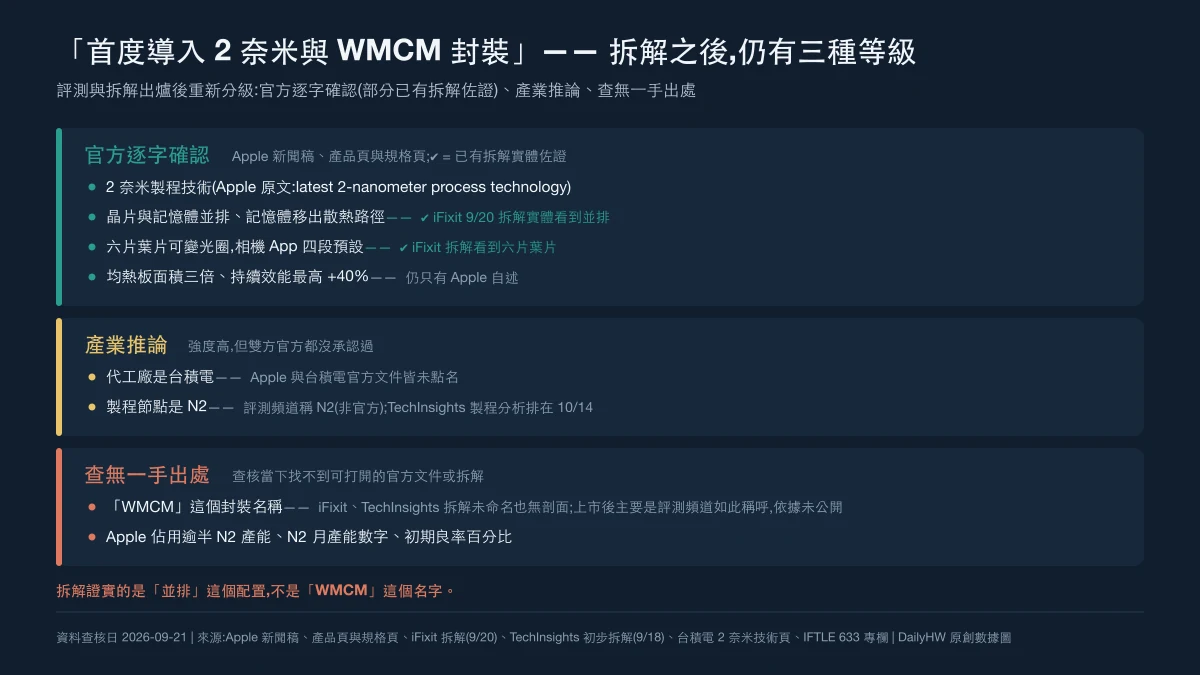
What Apple actually said
Everything below comes from Apple’s newsroom release, product page or specification page, not from secondary coverage. Where a third-party measurement or teardown now exists, I note it alongside.
Process. The release says the chip is “Built using the latest 2-nanometer process technology.” That is the entire disclosure. No TSMC. No N2. No N2P. As of September 21, “TSMC” appears zero times across Apple’s US and Taiwan newsroom releases, product pages and spec pages.
Silicon. A 6-core CPU (2 super cores and 4 efficiency cores per the spec page; the release says the CPU integrates Neural Accelerators), a 7-core GPU (listed on the spec page with Neural Accelerators), and a Dual 16-core Neural Engine. The release benchmarks everything against Apple’s own A19 Pro: 50 percent more memory bandwidth, GPU up to 40 percent faster, double the AI processing power. One detail that tends to get skipped: the A19 Pro had a 6-core GPU, so this generation adds a core.
The CPU figure depends on which page you read. The release describes the CPU only as “faster than the competition,” with no named rival and no generational number. Apple’s product page is more specific: its model-comparison module says “up to 20% faster 6-core CPU” against both the iPhone 17 Pro and 17 Pro Max, with no methodology footnote. The “21 percent” figure circulating online is something else again. It traces to Geekbench database listings reported by MacRumors on September 10, which the report itself labelled unconfirmed; it is not Apple’s number.
Now there are third-party numbers. Gizmodo’s Geekbench 7 run put the iPhone 18 Pro at 4,027 single-core and 11,540 multi-core, against 3,258 and 9,167 for the iPhone 17 Pro: 24 percent faster single-core and 26 percent faster multi-core. 9to5Mac’s review measured the CPU 22 to 27 percent faster, so neither fell short of Apple’s own 20 percent. The GPU needs splitting by model: 9to5Mac measured it 40 to 45 percent faster, while Tom’s Guide’s 3DMark Solar Bay run put the Pro Max 45 percent ahead but the 6.3-inch Pro only 33 percent ahead, below the top of Apple’s “up to 40 percent.” These are single reviewers on specific benchmarks.
Packaging. This is the most important sentence in the release, so here it is in full:
A20 Pro introduces custom packaging inspired by M-series Apple silicon that places the silicon die side by side with the memory, removing the memory from the thermal path of the chip and allowing A20 Pro to attach directly to a next-generation vapor chamber.
That sentence now has teardown support. iFixit’s September 20 teardown is blunt about it: last year’s A19 Pro sat with “RAM stacked above it,” while this year “the memory now sits beside the processor.” The A20 Pro has also moved from the inside of the logic-board sandwich to the outside, where it presses against the vapor chamber with only a thermal pad in between.
Thermals. Apple says the vapor chamber uses new materials and has three times the surface area of the one in the iPhone 17 Pro generation, and that sustained performance is up to 40 percent better than the previous generation. The teardowns show a visibly larger chamber, but “three times” is still Apple’s figure; iFixit repeats it rather than measuring it. The third-party sustained-load data is covered in the mechanism section below.
Battery. Taiwan gets the models that keep a physical SIM tray, and Apple Taiwan’s spec page rates them at up to 34 hours of video playback for the iPhone 18 Pro and 43 hours for the Pro Max. The 36- and 45-hour figures that most coverage quotes belong to the eSIM-only models sold in the US and a few other markets; Apple says those use the former SIM space for a larger battery, worth two more hours of video. The footnote conditions matter as much as the numbers: tested in July 2026 on preproduction hardware and preproduction software, looping a 2-hour-23-minute HDR film, with auto-brightness and True Tone switched off. The separate “typical use” figure comes from an August 2026 test using a usage profile Apple defines internally, which nobody outside can reproduce.
Apple does explain the gain in its release: the Pro Max’s longer battery life comes “thanks to advancements in Apple silicon and a larger battery.” Two factors, with no split between them. How much larger the battery got is something Apple has in fact disclosed, just not on the product page. Its EU product information sheets cover the same model numbers Taiwan receives (A3714 for the 18 Pro and A3717 for the Pro Max, which Apple’s support site lists as the “other countries and regions” versions). Rated capacity is 4,056 mAh for the iPhone 18 Pro and 5,391 mAh for the Pro Max, against 3,988 and 4,823 mAh for the equivalent previous-generation models. Those numbers come back in the battery discussion below.
Camera. The 48MP Fusion main camera gets a variable aperture, and the product page lists it at 2.44µm quad-pixel (1.22µm individual). The release describes six laser-cut blades that “smoothly transition” between apertures; the Camera app offers four manual settings, ƒ/1.48, ƒ/1.8, ƒ/2.8 and ƒ/4.0; and Apple provides an API that gives developers finer control across the aperture range. So “four stops” is the Camera app’s manual picker, not a limit of the hardware. PetaPixel’s review observed that in automatic mode the aperture adjusts steplessly between wide open and fully closed. It is on the main camera only; neither the ultra-wide nor the telephoto is mentioned.
Enclosure. Aluminium unibody, Ceramic Shield 2 on the front and Ceramic Shield on the back. The back one is not the 2; those two are easy to conflate.
Memory capacity. Neither the product page nor the spec page lists RAM. MacRumors read 12GB for both models out of Apple’s Xcode 27 developer tools on launch day, and TechInsights’ preliminary teardown confirms LPDDR5X but has not published a capacity.
The word “WMCM”: the teardowns settled half of it
Back to the packaging name that is now in every roundup.
WMCM stands for wafer-level multi-chip module, and it is described as integrating the processor and memory dies at wafer level without a separate silicon interposer. Specific-sounding. The problem:
Apple never said it. I searched the full text of the release, product page and spec page for “WMCM” and “wafer-level multi-chip module.” Every search returns zero. Apple describes what the packaging does and declines to name it.
Nor does the term appear in any TSMC document I could open. The 2nm technology page says only that N2 entered volume production in Q4 2025 as planned, using industry-leading first-generation nanosheet transistors, and TSMC’s April 2024 North America Technology Symposium release lists CoWoS, SoIC and System-on-Wafer as its packaging lineup. Neither contains the term. (TSMC’s 3DFabric packaging pages returned HTTP 403 to my fetches, so I cannot rule out that the term appears there. That cuts both ways: anyone claiming TSMC has publicly disclosed a WMCM roadmap cannot produce an openable link either.)
Trace the term upstream and the earliest public mention I could open is from June 3, 2025: 9to5Mac relaying a GF Securities note by analyst Jeff Pu, which said Apple would adopt WMCM for the first time and that TSMC would set up a dedicated line at its AP7 facility. That is roughly fifteen months before the iPhone 18 Pro was announced, and it is a brokerage note, not a statement by Apple or TSMC. A month later, on July 8, packaging analyst Phil Garrou’s IFTLE column “What’s Inside Apple’s A20 Chip” repeated it as “what’s being called” WMCM, flagged the details as reported, and said he could not find any publicly released cross-section of the package. I could not find a public source for who first coined the name. The term has been repeated ever since. Even TrendForce’s pre-launch forecast release of September 3 said memory packaging “will transition from InFO to WMCM”; that is an analyst forecast carrying a disclaimer, not a statement by Apple or TSMC.
The teardowns answered half the question.
- iFixit physically saw the side-by-side layout: memory has moved from sitting on top of the processor, as it did with the A19 Pro, to sitting beside it. That confirms the configuration Apple described.
- But iFixit neither names the package nor publishes a cross-section. TechInsights’ September 18 preliminary teardown says only that the A20 Pro is “paired with LPDDR5X memory,” and states that process technology, die design, packaging and memory configuration all await further reverse engineering; that analysis is scheduled for an October 14 webinar.
- The main source now calling it WMCM, and calling the process TSMC N2, is a September 16 video from the Chinese review channel Geekerwan, as relayed by Taiwanese tech media. Its basis for those calls is not public. It is a reviewer’s claim, not confirmation from either company or from a reverse-engineering firm.
So the accurate reading is this: the side-by-side layout is now a teardown-confirmed fact. The WMCM name, whether the package is actually built at wafer level, and whether the memory goes in as bare die or as a packaged part all still lack a primary source as of September 21. Until TechInsights publishes a cross-section, the term deserves the grammar of a rumour.
The same applies one level up: “the A20 Pro is fabricated by TSMC” has no primary source either. Apple never discloses foundries in product releases, TSMC never names customers in official documents, and the post-launch teardowns have not yet published their process analysis. The consensus is strong. Within the scope of what I could check, it is still only consensus.
What Apple actually changed — the mechanism needs no acronym
The interesting part is that Apple’s sentence plus the teardowns explain the mechanism perfectly well without the name.
For years Apple’s A-series chips have had DRAM stacked directly on top of the SoC, a package-on-package (PoP) arrangement. The stacking goes back at least to the A10 in 2016, which TechInsights identified at the time as a TSMC InFO wafer-level PoP, and iFixit’s chip ID for last year’s model still shows the A19 Pro “layered under” a 12GB Samsung LPDDR5X part. It is compact, but it puts the memory squarely in the chip’s upward thermal path.
A TSMC patent on PoP cooling describes the same stack’s thermal trade-off from the memory’s side. With the memory stack sitting on top of the processor package, the processor’s heat degrades temperature-sensitive memory, and the specification says placing the heat source near the memory stack “is not beneficial from a thermal management perspective”; the configuration persists because it raises integration density, and the patent’s fix is a heat ring that draws heat away from the memory.
Read Apple’s phrase, “removing the memory from the thermal path of the chip,” against that background and the causality is self-evident: the memory was in the thermal path, which is why it had to be moved. Side by side frees the top face of the SoC to bond directly to the vapor chamber, which is exactly what iFixit found.
What the thermal win may cost at the packaging step
Does side-by-side packaging carry a cost? Only general principles can be stated here, and they need to be stated carefully.
The old PoP approach had a manufacturing advantage: the top and bottom packages could each be tested before stacking. A 2006 PoP study co-authored by Amkor with Sharp and other firms lists “tested at individual package level” as a PoP feature in its comparison table, and in the same table flags a concern for stacked-die packages, where several bare dies share one package: known-good die (KGD) is required to keep product yield high. Note what that does not mean. Being able to test before stacking is not the same as being able to swap out a bad layer afterwards. A board-level rework specialist warns that on underfilled PoP stacks, the neighbouring device has a high likelihood of being damaged when the target part is removed.
Putting several dies into one package shifts yield risk onto the packaging step. A Synopsys technical article illustrates this with a multi-die package model: without screening before assembly, one defective die invalidates the whole package, taking the good dies with it. The industry’s answer is KGD testing, so that only known-good dies are assembled. With good screening, module yield is no longer simply the product of the individual die yields, though the same article cautions that some defects, such as a bad bump, escape single-die testing and only show up after assembly. A chiplet cost model from a team at Tsinghua University in Beijing (Chiplet Actuary), presented at DAC 2022, counts “wasted known good dies” from packaging defects as a separate cost: a die can pass its tests and still be lost if packaging or bonding goes wrong.
Where the A20 Pro sits among those principles, the public record cannot say. Apple has not disclosed the package’s structure or process: whether the memory goes in as bare die or as a packaged part, how it is bonded, or whether a failure can be reworked. TSMC does not name customers, and TechInsights’ packaging analysis is not out yet. So this article does not claim that the thermal benefit was bought with worse packaging yield. What can be said is narrower: change the package structure and you change the risk structure for yield and scrap, and the actual numbers sit with Apple and its foundry, not in public data. No specific packaging-yield percentage in circulation has a primary source.
Battery: nothing yet credits the package
One tempting link has to be blocked first: the packaging change acts directly on thermal resistance, and better heat dissipation maps first to sustained performance. Any effect on battery life would be indirect — a cooler chip leaking less, say, or a changed memory signal path. Before launch, IFTLE relayed reports that moving the chip closer to its memory could mean “potentially lower power consumption”; TrendForce listed the shorter signal path only under cooling and credited longer battery life to larger batteries. No public measurement has isolated the direction or size of such an effect. Crediting the Pro Max’s extra battery life to the new package has nothing behind it.
So where does the battery gain come from? Apple names silicon and a bigger battery without splitting them. But the EU product information sheets also give a cross-generation figure measured under one regulated method, battery endurance per charge cycle:
- iPhone 18 Pro: rated capacity 4,056 mAh, only 1.7 percent more than the previous generation’s 3,988 mAh; endurance 52 hours against 47, up 10.6 percent.
- iPhone 18 Pro Max: rated capacity 5,391 mAh, 11.8 percent more than 4,823 mAh; endurance 62 hours against 53, up 17.0 percent.
Divide endurance by capacity for a rough hours-per-mAh measure, and the Pro improves by about 8.8 percent while the Pro Max improves by about 4.7 percent. Two things follow: most of the Pro’s gain does not come from a bigger battery (capacity explains only about a sixth of it), while a large share of the Pro Max’s does. The remaining gain beyond capacity could come from 2nm efficiency, indirect effects of the package, or equally from the display, the modem or software. This ratio blends all of them together and cannot separate them.
Third-party tests also show how much the answer depends on the method. In Tom’s Guide’s test, continuous web browsing over 5G at 150 nits, the Pro Max averaged 18 hours 27 minutes, just 3.1 percent more than its predecessor’s 17 hours 54 minutes; the Pro ran 16 hours 17 minutes against 15 hours 21 minutes, up 6.1 percent. Apple’s video-playback claim, the EU’s standardized cycle and a reviewer’s web test all measure “battery life,” and the improvements they report differ several-fold.
Sustained performance: the stability gain is concentrated on the bigger phone
Apple’s “up to 40 percent” sustained-performance sentence in the release has the redesigned vapor chamber as its subject; the product page says the chamber “works with the A20 Pro chip design” to deliver it, and the release’s opening credits the A20 Pro and the new vapor chamber “together.” Apple does not split the credit between them.
The third-party comparison available so far is Tom’s Guide’s 3DMark Wild Life Extreme stress test, which loops a graphics benchmark 20 times. The Pro Max’s stability score rose from 65.2 percent to 79.4 percent; the Pro’s barely moved, from 61.1 percent to 62.8 percent. A stability score divides the worst loop by the best, measuring how much performance drops under prolonged load; that is not the same thing as Apple’s 40 percent, so it neither confirms nor refutes Apple’s figure. Nor does it mean the Pro’s sustained performance stood still: its ratio held flat, while the same review measured a peak GPU score about a third higher in a different test (3DMark Solar Bay). Tom’s Guide did not publish per-loop scores, but if the stress test’s peak rose too, a flat ratio means the worst loop rose with it — an inference, not a measurement.
The signal it does carry: both phones use the same A20 Pro in the same package, yet a clear stability gain shows up only on the larger Pro Max. That suggests the area the chassis and vapor chamber can spread heat across also matters for prolonged loads. The test cannot say whether the package or the chassis matters more, and it is one test, not a conclusion.
Which is also why the release’s two different 40 percents need keeping apart:
- GPU up to 40 percent faster, measured in the release against the A19 Pro. Graphics performance.
- Sustained performance up to 40 percent better, measured against the previous generation (the same sentence names iPhone 17 Pro). Behaviour under prolonged load.
The two figures use different baselines and different metrics. Apple’s product page credits both to the chip and the new vapor chamber working together, without splitting them; what is certain is that neither is the 2nm process’s doing alone. Writing either as “the A20 Pro is 40 percent faster” or “2nm delivers 40 percent more performance” is wrong.
What 2nm actually buys, and its ceiling
Since the process is the only fabrication fact Apple confirmed, what does it deliver?
N2 uses TSMC’s first-generation nanosheet transistor — gate-all-around, or GAA. Its advantage over FinFET comes from two separate mechanisms that routinely get blurred together:
Power efficiency comes from full gate wrap. Belgian nanoelectronics institute imec puts it directly: the conduction channel is now completely surrounded by the high-k metal gate, so gate control over the channel holds up at shorter channel lengths. FinFET wraps three sides; a nanosheet wraps four. Better electrostatic control suppresses leakage, which lets the chip hold the same switching behaviour at a lower supply voltage. That is where the power saving comes from.
Performance comes from vertical stacking. From the same imec article: stacking nanosheet channels vertically in a standard cell that only had room for a single fin yields a larger effective channel width, so drive current per unit footprint is higher than fins deliver. There is a flexibility FinFET cannot match: a FinFET’s effective width only changes in whole-fin steps, whereas nanosheet device width is variable (imec’s phrase is “variable device width”), giving designers a dial to trade drive current against area and capacitance.
How big is the gain? First, a detail that is easy to miss: I read the current version of TSMC’s official 2nm technology page line by line, and it offers only qualitative phrasing like “full-node strides in performance,” with no percentage for N2 against N3 or N3E (the percentages that do appear on the page describe newer nodes, A16 and A14, against the N2 family). The numbers live elsewhere. TSMC’s April 2023 Technology Symposium release says that against N3E, 2nm delivers up to 15 percent more speed at the same power, up to 30 percent less power at the same speed, and greater than 1.15x chip density, and the 2nm platform paper TSMC’s own authors presented at IEEE IEDM 2024 gives the same pair against N3, explicitly as 15 percent speed or 30 percent power.
Circle that “or.” The two numbers carry different conditions (same power versus same speed), so they are alternative operating points by construction, not a combined result, and secondary coverage routinely lists them as if they stack.
Put that ceiling next to Apple’s marketing and the conclusion falls out: the GPU’s 40 percent cannot have come from the node alone. At the same power, a full node is worth roughly 15 percent in speed. The GPU also went from 6 cores to 7, and the rest comes from some mix of architecture changes, that extra core or a higher power budget; Apple does not break it down. The 24 percent single-core CPU gain reviewers measured also exceeds that same-power ceiling. When we went through TSMC’s N2 margin structure, the cost of 2nm showed up on TSMC’s side of the ledger first; on this article’s own reading, the node alone accounts for only part of Apple’s generational numbers.
A final calibration: “2nm” does not correspond to any measurable dimension on the die. IEEE Spectrum’s examples are concrete — transistors on the so-called 130nm node actually had 70nm gates; Intel’s 22nm generation had 26nm gate lengths, a 40nm half-pitch and 8nm-wide fins. Node names decoupled from physical dimensions in the mid-1990s. They are generation labels now.
What the tier-by-tier arithmetic says about the cost pressure
Now the money.
Taiwan’s official pricing, checked SKU by SKU (all 32) on Apple Taiwan’s store on September 21 and unchanged since launch: iPhone 18 Pro at NT$44,900 (256GB), NT$51,900 (512GB), NT$66,900 (1TB) and NT$88,900 (2TB); iPhone 18 Pro Max at NT$49,900, NT$56,900, NT$71,900 and NT$93,900 for the same tiers.
Line those up against the previous generation tier by tier and the picture resolves.
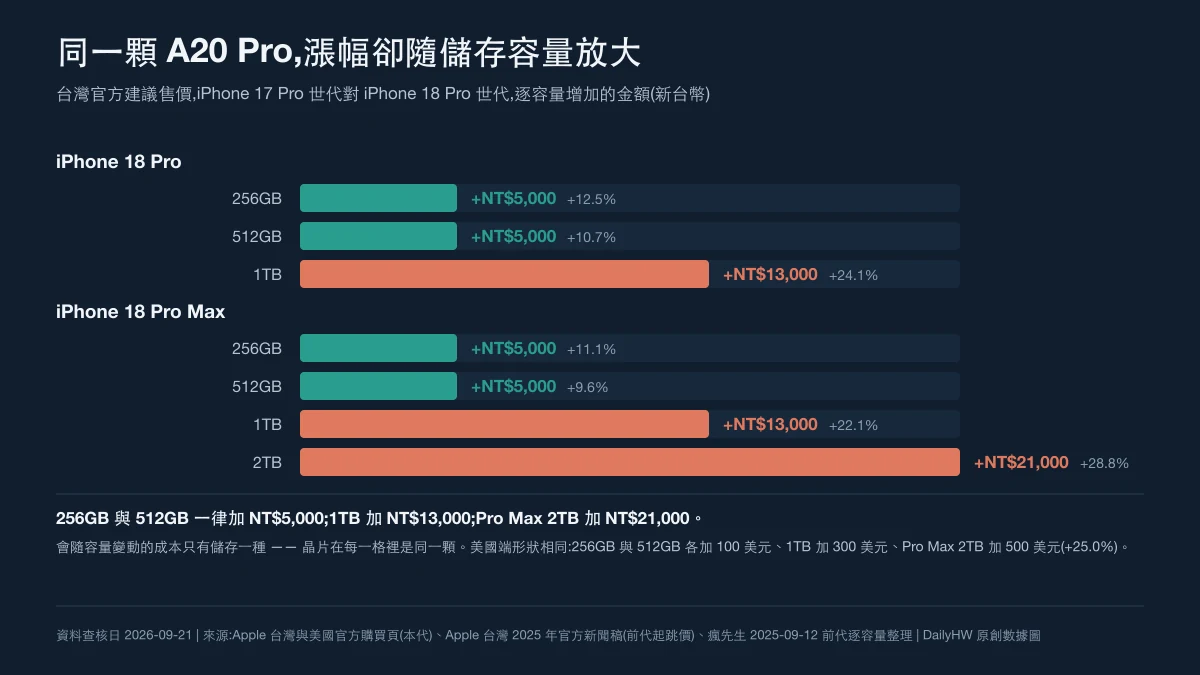
iPhone 18 Pro: 256GB from NT$39,900 to NT$44,900, up NT$5,000 (+12.5%); 512GB from NT$46,900 to NT$51,900, up NT$5,000 (+10.7%); 1TB from NT$53,900 to NT$66,900, up NT$13,000 (+24.1%).
iPhone 18 Pro Max: 256GB from NT$44,900 to NT$49,900, up NT$5,000 (+11.1%); 512GB from NT$51,900 to NT$56,900, up NT$5,000 (+9.6%); 1TB from NT$58,900 to NT$71,900, up NT$13,000 (+22.1%); 2TB from NT$72,900 to NT$93,900, up NT$21,000 (+28.8%).
(The 18 Pro’s 2TB tier is new this generation — the 17 Pro had no 2TB option — which is why it has no entry in the tier-by-tier comparison. A note on basis: these are all official recommended prices; Taiwan’s include 5 percent VAT while US list prices exclude state sales tax, so the two cannot be divided by an exchange rate and compared directly. This article only compares generational deltas within each market. The previous generation’s 256GB entry prices come from Apple Taiwan’s own 2025 release; 512GB and above come from contemporaneous local coverage, because Apple Taiwan stopped listing 17 Pro pricing once the new models launched, so those cannot be re-verified against an official page today. The Pro Max 2TB row is both the top of the table and the single most important piece of evidence in this section — read that sourcing caveat along with it.)
The US ladder follows the same pattern: +$100 at 256GB, +$100 at 512GB, +$300 at 1TB, and the Pro Max 2TB going from $1,999 to $2,499 — +$500, or 25 percent, the largest absolute jump in the entire line.
There is an independent way to check this. Divide each NT increase by its matching USD increase: 256GB and 512GB come to NT$50.0 per US dollar, 1TB to NT$43.3, and the Pro Max 2TB to NT$42.0. All three ratios sit far above the Bank of Taiwan’s posted spot selling rate of 31.855 at 16:01 on 2026-09-18, which tells you the two price lists each reflect their own tax and regional pricing rather than one being a currency conversion of the other. Note that the falling ratio does not mean Taiwan’s increases are smaller: converted at that rate, every Taiwan tier rose more than its US counterpart (the 1TB tier’s NT$13,000 is about US$408, against US$300). Cross-market absolute comparisons are therefore not usable as evidence here; generational deltas within one market are.
Now run a very simple check. The A20 Pro in the 256GB unit is the same chip as the one in the 2TB unit, and the 12GB of DRAM is the same too. If Apple passed costs through tier by tier and 2nm silicon were the main driver, every tier should have moved by roughly the same amount.
The increase actually splits into two parts.
The first is the NT$5,000 (US$100) every tier carries. That part contains the 2nm chip, but also the same DRAM, and the DRAM is not small change. TechInsights’ memory price tracker puts a 12GB (96Gb) mobile DRAM part at about $140 in June and about $165 at launch, while 256GB of NAND went from about $68 to about $82 over the same period (these are component price estimates, not a teardown bill of materials). In other words, even the flat, every-tier part of the increase cannot all be pinned on 2nm.
The second is the part that scales with capacity: 1TB rose NT$8,000 more than 256GB did, and the Pro Max 2TB NT$16,000 more. Same Pro Max, 11.1 percent at 256GB and 28.8 percent at 2TB. Only one component in a phone varies with capacity, and that is storage. So that part is not explained by chip cost differing across tiers; every tier has the same chip.
But that is not the same as “NAND cost.” Whether that part is cost pass-through or pricing strategy, the price list alone cannot tell, and there is a strong competing reading. Counterpoint’s August 11 report predicted that Apple would “deploy a tiered, asymmetric pricing strategy,” concentrating the increase on high-capacity variants; its reasoning was that the top tiers carry more cost-effective NAND, so “a larger nominal increase there is more margin-accretive than the same increase at 256GB.” 9to5Mac’s review reads the price list the same way: Apple appears to have eaten some margin on the 256GB and 512GB configurations and made it back on the higher tiers. On that reading, the extra increase at the top may be recovering costs absorbed lower down, including the 2nm chip and the DRAM.
A post-launch lead that fits this reading has also surfaced, though it is unconfirmed. Notebookcheck, relaying storage tests by the Chinese lab HOMOLAB, reports that the 1TB Pro Max uses QLC flash (cheaper per gigabyte, slower under sustained writes), while the 512GB Pro it tested was TLC. That is a second-hand report, and as of September 21 no teardown firm has confirmed it; TechInsights lists memory and NAND suppliers as follow-up work. If it holds, the capacity-scaled part of the increase becomes even harder to read as pure cost pass-through.
The memory market’s timeline, at least, lines up with this generation’s pricing. On February 2, TrendForce sharply raised its Q1 forecast, expecting LPDDR4X and LPDDR5X contract prices to rise around 90 percent quarter on quarter, the steepest increases in their history, and NAND flash to rise 55–60 percent instead of the 33–38 percent it had projected. On May 14 it estimated a further 78–83 percent rise in LPDDR5X average selling prices for Q2, and said that several consecutive quarters of steep increases had significantly intensified cost burdens for smartphone vendors. The increases were then expected to narrow: TrendForce’s August report summary puts Q3 mobile DRAM contract prices up about 8–13 percent quarter on quarter and expects Q4 increases to converge further without turning negative. Judging by the usual summer build schedule for new iPhones, the iPhone 18 Pro’s component buying should fall inside that window (Apple does not publish its build schedule, so this is inference). We have been following this thread for most of the year — from a 32GB DDR5 kit rising 14% in five days, and why waiting for the crash fails this cycle to a 4–5% NAND supply deficit and whether to buy a 2TB SSD or choose QLC. It has now reached phones. On TSMC’s July earnings call, Chairman C.C. Wei also said consumer and price-sensitive end markets were being challenged by rising component prices and macroeconomic uncertainty.
Counterpoint’s cost estimate in the same report: the bill of materials for an iPhone 18 Pro Max in a 12GB-plus-1TB configuration rises by close to US$300 versus its predecessor, with the 256GB and 512GB Pro variants up US$200–250, driven by DRAM average selling prices rising 400 percent and NAND more than 300 percent over the preceding twelve months, plus the move to 2nm.
Three qualifiers travel with that number. First, it is a model estimate, not a teardown, published before the announcement; as of September 21 no teardown-based bill of materials had been published, and TechInsights lists its bill of materials and manufacturing cost analysis as still in progress. Second, DRAM rising 400 percent is a twelve-month market average, not the increase in one phone’s memory cost; the two must not be stacked. Third, the same report points the other way on the top tiers — in one place it says conditionally that Apple “could use” more cost-effective NAND there, and in another it states that Apple “aims to deploy” such solutions to maximise margin. That undercuts the tidy story that high-capacity pricing is pure cost pass-through, and it comes from the same document as the cost estimate, so it does not get to be left out.
There is also a blunter counterexample. The first 3nm phone chip in history was the A17 Pro, in the iPhone 15 Pro. What did that generation cost at launch? $999 — identical to the iPhone 14 Pro. Not a dollar more. A node transition does not automatically mean a higher retail price. (In fairness: that same year the iPhone 15 Pro Max went from $1,099 to $1,199, but base storage simultaneously doubled from 128GB to 256GB, so that was more for more. This time the $100 arrives with base storage unchanged, which makes it a cleaner increase.)
So the honest conclusion for this section: Apple has never explained the price increase. Neither the release nor the website attributes pricing to memory, tariffs or process. But if you are going to infer in the absence of an official explanation, the tier-by-tier structure is the hardest evidence available, and what it rules out is one explanation: chip cost differing by tier, since every tier carries the same A20 Pro. Whether the capacity-scaled part is NAND cost, or Apple concentrating the overall increase, chip and DRAM included, on the top tiers, the public record can only say that either is possible.
Taiwan’s supply chain: nobody admits to being in this phone
I expected to write this section as “Taiwanese suppliers cash in.” The data says otherwise.
Start with TSMC. The primary source is its Q2 2026 earnings release filed with the SEC: 2nm accounted for just 3 percent of wafer revenue, against 30 percent for 3nm and 33 percent for 5nm.
For the earnings call, the platform mix and management remarks here follow the official transcript posted on TSMC’s investor relations site (an LSEG StreetEvents edited transcript; the site blocks scripted downloads but opens normally in a browser), cross-checked item by item against the Motley Fool transcript. The latter notes that parts of it were created using large language models, and it does contain transcription errors, so where the wording differs I quote TSMC’s version.
On that basis: high performance computing was 66 percent of revenue and grew 20 percent sequentially, while smartphone was 22 percent and declined 4 percent. Wei said the third quarter would be “supported by continuous strong demand for our leading-edge process technologies, including the steep ramp up of our 2-nanometer technology,” while CFO Wendell Huang said that same 2nm ramp would dilute gross margin by about 3 to 4 percentage points in the second half.
The capacity picture needs to be stated in full. The only capacity TSMC called “tight” on the call was packaging: Wei said packaging capacity is “so tight that now it limits my customers’ growth.” The only “shortages” it named were back-end capacity, testers, and mature-node power management ICs and sensors, which Wei said are “in shortage, definitely.” But leading-edge front-end capacity was not described as comfortable either. Asked whether demand for 3nm and below, which analysts assume runs 30 to 50 percent above TSMC’s ability to supply, is in fact even larger, Wei declined to give a number but said “the gap is very big.” In another answer he said TSMC is working with customers to “allocate the wafer” to balance CPU, GPU and other AI-chip ratios.
So neither “phones are grabbing AI’s 2nm capacity” nor the reverse, “AI is squeezing out phones,” can be established from this call. TSMC acknowledges that demand for 3nm and below outstrips supply, but it did not say how that gap is split between AI and smartphone customers. What is verifiable is the revenue mix: HPC drives the growth. Two further qualifiers: Q2 covers April to June, the seasonal trough for smartphones, so a 4 percent sequential decline is normal; and TSMC has never disclosed platform allocation within a specific node, so revenue mix is not a proxy for capacity allocation. It is consistent with what we saw looking at AI capex and where the real constraint sits: AI is what is carrying TSMC’s current growth.
N2 capacity and pricing: what the public record contains, and what it does not
Since this is an N2 story, it is worth being precise about how much is actually knowable on capacity and pricing.
Pricing: TSMC never publishes wafer quotes. The most widely circulated figure puts an N2 300mm wafer at roughly US$30,000, against about US$25,000–27,000 for 3nm — an increase of some 10 to 20 percent, far below the 50 percent the market had speculated about earlier. Three qualifiers travel with it: the report is from October 2025; the source is TechNode relaying an industry figure from Chinese outlet Icsmart, which makes it third-hand with no TSMC confirmation; and it is a foundry quote, not what Apple actually pays, with large-customer discounts unknown. More than eleven months on from that report, with N2 now ramping, the number may well have moved.
More importantly: a wafer price is not a per-chip cost. Getting to the cost of a good die means dividing the wafer price by (gross dies per wafer × yield) and then adding advanced packaging. Neither TSMC nor Apple has published any of those three variables. So every “the A20 Pro costs $X per chip” figure in circulation is an outside estimate, not a verifiable fact.
Capacity: TSMC does not publish absolute monthly N2 wafer starts either. The figures going around — 50,000–60,000 wafers a month by end-2026, a push toward 100,000, capacity booked out to 2028, Apple taking more than half of N2 — I could not trace any of them to an openable primary source, and different outlets contradict each other. What is verifiable comes down to these: N2 entered volume production in Q4 2025 as planned (official technology page); the 2026 capital budget of US$60–64 billion, with 70–80 percent going to advanced process technologies and 10–20 percent to advanced packaging, testing, mask making and others (earnings call); the 3 percent of Q2 wafer revenue noted above; the call’s announcement of an additional US$100 billion in Arizona for “several more semiconductor logic wafer fabs for 2-nanometer and below technologies” plus advanced packaging fabs, with no timeline or capacity figure; and one line on the call that bears on 2nm capacity growth. TSMC’s head of investor relations restated a symposium chart showing roughly 70 percent five-year compound growth in 2nm capacity and asked whether it had changed; Wei answered, “now is bigger.” That is a growth rate, not an absolute number.
None of those converts into “how much N2 capacity Apple takes.” That question has no verifiable answer in the public record — which is different from saying there is one I failed to find.
This loops back to pricing rather neatly. If the A20 Pro is on TSMC N2, as the industry assumes but no primary source confirms, and N2 wafers cost more than N3, as the third-hand reports say, that cost lands on the die. Whatever the amount, it is a fixed cost: the chip inside a 256GB unit and a 2TB unit is identical, and so is its cost. It can explain part of why the generation is more expensive overall (the same DRAM explains another part). A difference in chip cost cannot explain why the 1TB tier’s increase (NT$13,000) is 2.6 times the 256GB tier’s (NT$5,000), since every tier carries the same chip.
August monthly revenue from Taiwanese component makers splits too sharply to summarise in one line:
- Hon Hai (Foxconn): NT$921.77 billion, up 51.98 percent year on year, its strongest-ever August. The company said its cloud and networking division grew significantly on AI momentum, and that smart consumer electronics also grew significantly year on year as clients rebuilt inventories ahead of new product launches and shipment prices moved higher (that division fell from July). It did not name Apple, and gave no split between divisions.
- Pegatron: NT$88.305 billion, up 34.11 percent. Impressive until you see that the January-to-August cumulative figure is up just 1.49 percent. By this site’s calculation from the reported figures, August 2025 came to about NT$65.8 billion, roughly a quarter below that year’s January–July monthly average of about NT$88.1 billion, while August 2026 was only about 2 percent above this year’s January–July average of about NT$86.4 billion — so most of the 34 percent is base effect. The report says networking, automotive and servers grew year on year alongside phones, and the “iPhone 18 Pro pull-in” attribution is explicitly credited to analysts, not to Pegatron.
- Genius Electronic Optical: NT$2.719 billion, up 12.26 percent month on month and a near three-year monthly high — but only 0.72 percent year on year. The company’s own explanation is that more phone lenses were offset by fewer VR units, changing the product mix.
- Largan Precision: NT$5.012 billion, down 16.2 percent year on year.
Those last two look jarring side by side, but resist over-reading them: the comparisons differ. Genius’s “high” is a monthly revenue level, with year-on-year growth of only 0.72 percent that the company puts down to product mix, while Largan also supplies many non-Apple customers. A single month’s revenue can tell you neither end demand nor share shifts.
As for the variable aperture, the headline optical feature — who makes the lens and the actuator? As of September 21, I still could not find a single named supplier backed by an openable primary source.
The supplier lists that circulated before launch all trace back to one analyst’s social posts, whose original pages would not open at the time of checking, and the companies they named — Sunny Optical and Luxshare — are Chinese, not Taiwanese (some Chinese-language coverage describes Sunny as a Taiwanese firm, which is wrong). Around launch, Taiwanese media relaying brokerage supply-chain checks named Largan as the main supplier of the variable-aperture lens, but other reports contradict the details, and neither Largan nor Apple has confirmed it; the post-launch iFixit and TechInsights teardowns have not identified the module’s supplier either. Until there is a verifiable primary source, this site will not name any company as the iPhone 18 Pro’s variable-aperture supplier.
One timing note on all of the above: TSMC’s process and revenue disclosures currently run only through Q2 (published July 16) and August monthly revenue. The Q3 results that would actually reflect iPhone 18 Pro production arrive with October’s earnings call. Everything visible today is a build-phase leading indicator, not a sales result.
Variable aperture: the teardown found the hardware, the reviews measured the benefit, and it is smaller than billed
Start with the hardware. iFixit took the main camera apart and found six overlapping “polymer composite” blades, each about as thin as a human hair, driven magnetically. Its verdict is direct: the tolerances are tight and the glues are gummy, so the mechanism is about as close to unrepairable as it gets, and damage to the main camera will probably mean replacing the whole assembly. The 17 Pro’s main camera assembly is $249, and iFixit expects this one to cost more.
Apple’s quantified camera commitments go one step further than most coverage says. Beyond the aperture stops and 48 megapixels, the product page credits ƒ/1.48 with “around 50 percent better low-light performance” compared with the previous generation, with no test method given. That figure roughly matches the optics: iFixit notes that ƒ/1.48 is about half a stop wider than the 17 Pro’s main camera, and half a stop is about 40 percent more light. In other words, most of that 50 percent looks like light gathered by the wider aperture. That is my inference; Apple does not break the figure down.
With the embargo lifted, the third-party data is in:
- DXOMARK’s camera test, published September 19 Taiwan time, scores the iPhone 18 Pro at 172. It calls the variable aperture “a particular strength” that keeps more subjects sharp in group shots and complex scenes, and ranks the phone among the strongest-performing devices overall in low light, but it also notes that flare remains quite visible when the iris is closed.
- 9to5Mac shot the same night scene at the same 1/15-second shutter speed: the iPhone 18 Pro chose ISO 10,000 where the iPhone 17 Pro chose ISO 12,500. One example, not a controlled test, but the direction matches a wider aperture.
- The Verge’s review concluded that “the low light gains in the 18 Pro look pretty minor.”
Two optical points can now be checked against measurements.
Stopping down costs you something, but less than theory alone suggests. Going from ƒ/1.48 to ƒ/4 is about 2.9 stops, roughly 7.3x less light, which is a real loss in dim conditions. Phone sensors are small, so diffraction also becomes a limit early: using the standard Airy disc relation (diameter ≈ 2.44 × wavelength × f-number) at 550nm green light, ƒ/1.48 gives about 1.99µm, ƒ/2.8 about 3.76µm and ƒ/4 about 5.37µm. Apple’s product page lists the main camera at 1.22µm per pixel (2.44µm quad-pixel); against that, the ƒ/4 Airy disc is more than four times a single pixel and more than twice the binned pixel. In theory, then, the depth of field you buy at ƒ/4 is paid for in resolution. PetaPixel’s side-by-side shooting found that sharpness does dip at ƒ/4 from diffraction, “but not substantially”; ranked from sharpest to softest the order was ƒ/2.8, ƒ/1.8, ƒ/4 and ƒ/1.48, so the softest setting is actually wide open.
The industry has tried this and walked away from it. Samsung shipped a dual aperture (ƒ/1.5 and ƒ/2.4) on the Galaxy S9 back in 2018, carried it through the S10 and Note 10, then removed it entirely on the Galaxy S20 in 2020, substituting ToF depth sensing and computational photography. iFixit cites Samsung’s stated reason as “limited functional benefit at smartphone camera levels.” This is not a prediction that Apple will abandon it — six blades is a different class of hardware — but it does dispose of the “unprecedented breakthrough” framing.
DXOMARK’s own position piece is the fairest summary: having a variable aperture does not by itself mean better image quality; the benefit depends heavily on how the manufacturer tunes and integrates it into the imaging pipeline. It lists four situations that genuinely benefit — group shots needing more depth of field, focus tolerance, low light at wide aperture, and video under flickering light where a smaller aperture buys a longer shutter. DXOMARK’s own test has now answered the first positively. As of September 21, no public test covers the flicker-video case.
Buy now or wait? The trade-off changed once the reviews landed
First, look back at the September 18 first wave.
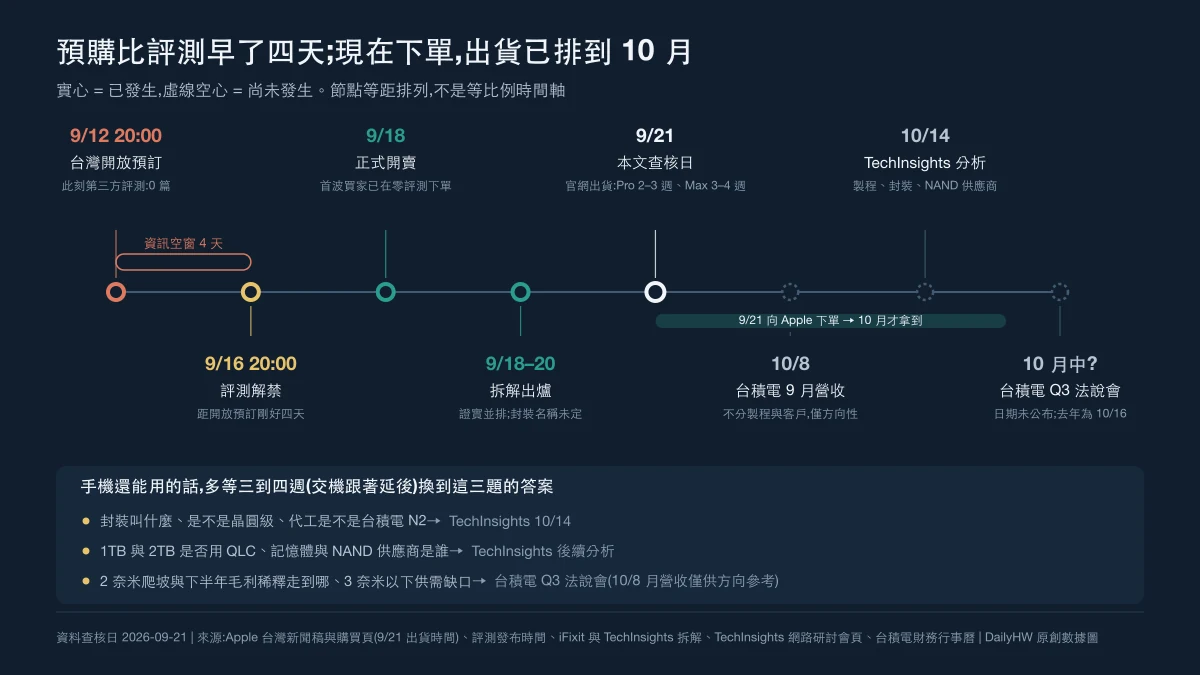
Third-party reviews for the last three iPhone Pro generations all landed two to three days before general availability: iPhone 17 Pro on September 17, 2025 (on sale September 19), iPhone 16 Pro on September 18, 2024 (on sale September 20), iPhone 15 Pro on September 19, 2023 (on sale September 22). This generation followed the pattern: reviews went live at 8 p.m. Taiwan time on September 16, exactly four days after Taiwan pre-orders opened. Anyone who secured first-wave stock did it with zero third-party reviews in hand.
Those who waited for the reviews learned three things. Third-party CPU gains did not fall short of Apple’s 20 percent, and GPU gains landed between 33 and 45 percent depending on the model and test. The stability gain under prolonged load, in Tom’s Guide’s stress test, is concentrated on the Pro Max. And the variable aperture is useful, but by a smaller margin than the marketing tone suggests.
So, looking back at September 18: both groups paid the same official price, and the difference was delivery. The Economic Daily News advertorial section reported on September 15 that the retailer Jie Sheng (傑昇通信) saw Apple’s site on September 14 already quoting deliveries after October 2 for every iPhone 18 Pro and three to four weeks for every Pro Max, so ordering from Apple after the reviews meant getting the phone roughly two weeks or more later (retailers had only some configurations in stock on launch day). For anyone whose phone still worked, those three answers were worth the extra couple of weeks, so waiting was the better call; for anyone certain to buy regardless, the first wave cost nothing extra. That moment has passed; for anyone who has not ordered yet, the judgment is below.
So what about now, as of September 21? The current facts first:
- Shipping times: checked on Apple Taiwan’s store at midday on September 21, every iPhone 18 Pro configuration showed “ships in 2–3 weeks” and every Pro Max “3–4 weeks,” identical across colours and capacities, with up to five working days for delivery after shipping. In other words, an order placed with Apple today arrives in October.
- Retailer list prices and stock (these are shelf prices, not transaction prices; this site has no transaction-price data): the September 18 launch page of Landmark (地標網通), a Taiwanese phone retail chain, discounts only the Pro Max 2TB, by NT$3,910 to NT$89,990, and lists every other tier at Apple’s price (unchanged when checked on September 21), with some configurations in stock at its stores; on launch day Costco’s Neihu store in Taipei listed the iPhone 18 Pro 256GB at NT$43,399, NT$1,501 below Apple. On the carrier side, Chunghwa Telecom’s 18 Pro 256GB still costs NT$2,300 even on its top plan (NT$2,699 a month over 48 months), its first iPhone launch without a NT$0 plan; the Pro Max 256GB reaches NT$0 only with trade-in or VIP discounts.
- Software: iOS 27 shipped on September 14. As of September 21, Apple’s security-releases list shows no 27.0.x update (that list only covers security releases, so treat it as indicative). The precedent: the iPhone 15 Pro overheating episode in 2023 was, by Apple’s own account, a bug in iOS 17, and the fix, iOS 17.0.3, shipped 12 days after the phones went on sale, with release notes explicitly addressing an issue that could cause iPhone to run warmer than expected.
- Repairs: iFixit’s teardown has three findings with a price attached. The aperture mechanism is effectively unrepairable on its own; the plastic frame around the display cracked or pulled away in three of the four phones iFixit opened (iFixit stresses that four units are too few to establish a failure rate); and NAND storage now sits inside the logic-board sandwich, making data recovery harder.
- Materials: after the iPhone 17 Pro moved to an anodised aluminium enclosure in 2025, marks on display units became a story. Apple’s explanation, five days after launch, was that the marks were material transfer from worn in-store MagSafe stands, removable with cleaning, while also acknowledging that the edges of the camera plateau may show normal wear and tear, including small abrasions, over time (the same report found the rest of the body highly scratch-resistant). The iPhone 18 Pro continues down the same aluminium path, so that variable is still open.
And what about skipping the new model to buy last year’s? Apple has closed most of that route this year.
- The iPhone 17 Pro and 17 Pro Max were pulled from Apple’s online store on September 9, announcement day, and Apple Taiwan’s 17 Pro store page now simply redirects to the general iPhone page. Only channel stock remains.
- Apple Taiwan’s refurbished store has no iPhone category (rechecked on September 21: it offers categories such as Mac, iPad, Apple TV and accessories).
- The older models still on sale went up, not down: the iPhone 17 is NT$32,900 at 256GB against NT$29,900 at its 2025 launch, and the iPhone Air now starts at NT$39,900 against NT$36,900 at launch — NT$3,000 more for each. TrendForce anticipated this in August, predicting that Apple might raise older-model prices alongside the new launch to offset memory costs.
- In the channel, Landmark’s price table dated September 21 lists the 17 Pro 256GB at NT$37,490, NT$7,410 below Apple’s price for the 18 Pro 256GB.
So, three cases, premised on prices and shipping times staying where they were on September 21:
If your current phone still works, wait until mid-October to decide. Waiting has a cost: if lead times hold at September 21 levels, an order placed with Apple in mid-October arrives in early November for the Pro and mid-November for the Pro Max, three to four weeks later than ordering now, and anyone who wants a phone immediately can find some configurations in stock at retailers. But if your phone still works, that delay is cheap, and it buys answers to this generation’s open questions: TechInsights’ process and packaging analysis on October 14 (what the package actually is, whether the high-capacity models use QLC), TSMC’s third-quarter call (mid-October last year), and whether the first iOS 27 fix has shipped.
If you are buying, pick the model before the capacity. If your reason for upgrading is “the thermals are better this year,” the one third-party stress test that publishes stability ratios for both models (Tom’s Guide) shows the clear stability gain on the Pro Max; the 6.3-inch Pro’s stability ratio barely moved, even though its peak GPU score in a separate test (Solar Bay) is also about a third higher. On capacity, the 256GB and 512GB tiers carry the smallest increases in the line (NT$5,000); the 1TB and 2TB tiers are where this generation’s price rise actually lands, and whether they use QLC is still awaiting teardown confirmation. Choosing 256GB costs NT$22,000 less than 1TB and NT$44,000 less than 2TB; of that, the extra generational increase concentrated on the top tiers is NT$8,000 at 1TB and NT$16,000 on the Pro Max 2TB. TrendForce does not expect NAND supply to loosen until the second half of 2027, and TechInsights expects memory prices to keep rising into 2027. If you do not need a lot of local storage, a smaller tier plus iCloud or external storage is the most direct saving available this generation.
If your plan was to save money on last year’s model, check real quotes first. There is no new 17 Pro on Apple’s site, and the iPhone 17 and Air are each NT$3,000 dearer. A channel 17 Pro 256GB sits about NT$7,400 below an 18 Pro 256GB. The difference buys the A20 Pro, the thermals of the side-by-side package and the variable aperture; if battery life is what you care about most, the gap between the two Pro generations depends on the test: 10.6 percent on the EU’s standardized cycle, 6.1 percent in Tom’s Guide’s web test. That is real progress, but battery life alone is not a strong reason to pay about NT$7,400 more.
Five numbers I will be watching
One: TechInsights’ A20 Pro process and packaging analysis on October 14. It could answer three things at once: what the package is called and whether it is wafer-level; whether the foundry and node are TSMC N2; and who supplies the memory and NAND, including whether the 1TB and 2TB tiers use QLC. The webinar date is TechInsights’ own; what it actually covers will be known on the day.
Two: GSMArena’s Active Use Score. As of September 21 the iPhone 18 Pro’s spec page still has none. The prior-generation baselines are 15:23h for the 17 Pro and 17:58h for the 17 Pro Max. It will add a fourth yardstick alongside Apple’s video figure, the EU’s standardized cycle and Tom’s Guide’s web test.
Three: Apple Taiwan’s shipping times. On September 21 they were 2–3 weeks for the Pro and 3–4 weeks for the Pro Max, identical across colours and capacities. A move to immediate shipping would signal supply catching up with demand. The 2025 comparison: SET News reported on September 16, 2025 that the Taiwanese retailer Jie Sheng (傑昇通信), four days before the iPhone 17 launch, saw Apple’s Taiwan site showing two-to-three-week waits for the iPhone 17 and 17 Pro and close to 30 days for the 17 Pro Max. Note that last year’s reading was taken before launch and this year’s after, and both are single-point observations by a retailer or this site, not Apple statistics.
Four: memory pricing — but look at the right column. On TrendForce’s public pricing pages, DRAM spot prices update intraday (already updated at 11:00 on September 21), but the free NAND spot table was last updated on September 7, and the DRAM contract table still shows the second half of July (last updated July 31) — 52 days old as of September 21. Use the free pages to track DRAM spot pressure; use the contract table and you are making today’s decision on seven-week-old data. Mobile DRAM contract pricing, the closest proxy to phones, updates quarterly and lags most of all.
Five: TSMC’s September monthly revenue (October 8) and its third-quarter earnings call. As of September 21 the call date was still not on the investor calendar; last year’s was October 16. Watch three things: 2nm’s share of wafer revenue (3 percent in Q2), where Huang’s “3 to 4 percentage points of gross margin dilution in the second half” actually lands, and whether Wei’s description of the supply gap at 3nm and below changes. Taiwan-listed companies must publish the prior month’s revenue by the 10th, rolling to the next business day around holidays. The caveat: TSMC’s monthly revenue is not broken out by node or customer, and Hon Hai’s and Pegatron’s include large non-Apple businesses, so these are directional signals only.
Back to the sentence everybody is running.
“The iPhone 18 Pro is the first with 2nm and WMCM packaging.” With the reviews and teardowns in, the first half is still Apple’s. In the second half, the side-by-side layout has been confirmed by teardown, while the name “WMCM” and the role of TSMC have still never been stated by either company. The most substantive thing Apple actually did say carries no technology name at all: it moved the memory out of the chip’s thermal path.
As for the extra money: the NT$5,000 every tier carries contains both the 2nm chip and the same DRAM, and the part that scales with capacity is not a difference in chip cost — every tier has the same A20 Pro — but a function of the storage tier you pick. Whether it is NAND cost or Apple concentrating the overall increase on the top tiers, the price list will not tell you. NT$5,000 more at 256GB, NT$13,000 more at 1TB. Same chip in both.
The brightest line on the spec sheet and the steepest part of this generation’s price rise are not the same thing.
Checked 2026-09-21. Pricing, specifications and availability come from Apple’s own pages. TSMC process and financial figures come from TSMC’s official technology page, its filings with the US Securities and Exchange Commission and the official earnings-call transcript on its investor relations site, cross-checked against the Motley Fool transcript. TSMC’s, the SEC’s, the Bank of Taiwan’s and Notebookcheck’s sites block scripted access (Cloudflare-style challenge pages), so this site checked them in a regular browser or via date-stamped historical pages. Sources: Apple newsroom release (2026-09-09: A20 Pro specifications, packaging description, vapor chamber, smoothly transitioning aperture and developer API, battery gain credited to Apple silicon and a larger battery, two extra hours on eSIM models), Apple iPhone 18 Pro product page (up to 20% faster CPU than 17 Pro, around 50% better low-light performance, main camera 2.44µm quad-pixel / 1.22µm individual, GPU and sustained-performance 40% credited to chip and vapor chamber together), Apple iPhone 18 Pro technical specifications (core configuration and GPU Neural Accelerators, four aperture settings, enclosure materials, US-model battery ratings and test footnotes), Apple Taiwan iPhone 18 Pro technical specifications (Taiwan-model video playback of 34 and 43 hours), Apple Taiwan newsroom release (pre-orders 8 p.m. Taiwan time Sept 12, availability Sept 18), Apple Taiwan buy page (per-SKU Taiwan pricing, purchase limit, shipping times on 2026-09-21), Apple US buy page (per-capacity US pricing), Apple Taiwan iPhone 17 buy page (NT$32,900 as of 2026-09-21), Apple Taiwan iPhone Air buy page (NT$39,900 as of 2026-09-21), Apple Taiwan newsroom (2025-09: iPhone Air from NT$36,900), Apple Taiwan newsroom (2025-09: iPhone 17 Pro from NT$39,900, 17 Pro Max from NT$44,900), Apple Taiwan newsroom (2025-09: iPhone 17 from NT$29,900), Apple Taiwan refurbished store (no iPhone category), Apple newsroom (2025-09: iPhone 17 Pro starting at $1,099, A19 Pro with a 6-core GPU), Apple newsroom (2023-09: A17 Pro as the industry’s first 3nm chip, iPhone 15 Pro holding at $999), Apple EU product information sheet: iPhone 18 Pro (A3714, rated 4,056 mAh, 52-hour endurance per cycle), Apple EU product information sheet: iPhone 18 Pro Max (A3717, 5,391 mAh, 62 hours), Apple EU product information sheet: iPhone 17 Pro (A3523, 3,988 mAh, 47 hours), Apple EU product information sheet: iPhone 17 Pro Max (A3526, 4,823 mAh, 53 hours), Apple Support: identify your iPhone model (A3714 and A3717 as the physical-SIM “other countries and regions” models), Apple security releases (iOS 27 released 2026-09-14), TSMC official 2nm technology page (Q4 2025 volume production, first-generation nanosheet, no percentages versus N3E on the page), TSMC April 2024 North America Technology Symposium release (packaging lineup lists CoWoS, SoIC and System-on-Wafer; no WMCM), TSMC April 2023 Technology Symposium release (2nm versus N3E: up to 15% speed at the same power, up to 30% less power at the same speed, >1.15x density), TSMC IEDM 2024 2nm platform paper abstract (15% speed or 30% power, >1.15x density, versus N3), TSMC Q2 2026 earnings release filed with the SEC (N2 at 3% of wafer revenue, revenue by technology), TSMC investor relations Q2 2026 results page (includes the official Earnings Conference Transcript: platform mix, Q3 outlook naming the 2nm ramp, 3-4 point second-half margin dilution, capital budget and allocation, additional US$100 billion in Arizona for 2nm-and-below fabs, packaging capacity “so tight,” the supply gap at 3nm and below, wafer allocation, mature-node power management IC and sensor shortages, 2nm capacity growth, consumer markets challenged by rising component prices), Motley Fool earnings call transcript (third-party, used for cross-checking), TSMC investor relations financial calendar (monthly revenue release dates), TSMC PoP cooling patent US10269676B2 (a processor near the memory stack is not beneficial from a thermal management perspective), TechNode (2025-10-09: industry estimate of roughly US$30,000 for an N2 wafer against US$25,000-27,000 for 3nm, relaying Chinese outlet Icsmart), imec on nanosheet transistors (gate-all-around control and vertical stacking), IEEE Spectrum (node names decoupled from physical dimensions), 9to5Mac (2025-06-03: relaying GF Securities analyst Jeff Pu’s note that Apple would adopt WMCM for the first time, with a dedicated TSMC line at AP7), IFTLE 633 (2025-07-08: relaying the WMCM label as “what’s being called,” author noting no public cross-section), TechInsights A10 product page (TSMC InFO wafer-level package-on-package), iFixit iPhone 17 Pro chip ID (A19 Pro layered under 12GB LPDDR5X), iFixit iPhone 18 Pro and Pro Max teardown (2026-09-20: memory beside the processor, six-blade aperture, display frame damage, NAND placement), TechInsights iPhone 18 Pro Max preliminary teardown (2026-09-18: LPDDR5X, process and packaging analysis to follow), TechInsights iPhone 18 Pro webinar page (2026-10-14: process and packaging analysis), Kocpc (2026-09-18: relaying Geekerwan’s review calling the A20 Pro TSMC N2 with WMCM), Amkor et al. (2006 PoP stacking study; comparison table lists PoP as tested at individual package level and stacked-die packages as requiring KGD), Synopsys (production test of multi-die packages: without screening one bad die scraps the package, KGD strategy, defects that escape single-die testing), Chiplet Actuary (DAC 2022: cost of known good dies wasted by packaging defects), BEST Inc. PoP rework service (neighbouring devices on underfilled stacks at high risk of damage on removal), TrendForce (2026-02-02: raised 1Q26 forecast, LPDDR around +90% QoQ, NAND +55-60%), TrendForce (2026-05-14: estimated 2Q26 LPDDR5X +78-83% QoQ, intensifying smartphone vendor cost burden), TrendForce (2026-07-30: NAND supply loosening in 2H27), TrendForce (2026-08-10: Apple may raise older-model prices at the new launch), TrendForce (2026-09-03: pre-launch forecast of memory packaging moving from InFO to WMCM), TrendForce mobile DRAM contract page (3Q26 around +8-13% QoQ, 4Q26 increases converging), TrendForce DRAM pricing page (spot updated 2026-09-21, contract table last updated July 31), TrendForce NAND spot pricing page (free table last updated 2026-09-07), TechInsights memory price tracker (2026-09-10: 12GB mobile DRAM and 256GB NAND prices, rising into 2027), Counterpoint Research (2026-08-11: BOM up US$200-300; predicting tiered, asymmetric pricing, with more cost-effective NAND on top tiers making increases there more margin-accretive), Notebookcheck (2026-09-21: relaying HOMOLAB’s finding that the 1TB Pro Max uses QLC), MacRumors (2026-09-09: 12GB RAM confirmed from Xcode 27), MacRumors (2026-09-10: unconfirmed Geekbench database listings, the source of the 21-23% figures), MacRumors iPhone 18 Pro review roundup (2026-09-16), Gizmodo review (2026-09-16: Geekbench 7 +24% single-core, +26% multi-core), Tom’s Guide review (2026-09-16: 3DMark stress-test stability, Solar Bay GPU +33% on Pro and +45% on Pro Max, 5G web-browsing battery test), 9to5Mac review (2026-09-16: measured CPU 22-27% and GPU 40-45% faster, margin reading of the price list, night-scene ISO comparison, US per-tier prices for both generations), DXOMARK iPhone 18 Pro camera test (172 points, variable aperture assessment and flare), PetaPixel camera review (stepless aperture in auto mode, sharpness by aperture), The Verge review (low-light gains pretty minor), GSMArena iPhone 18 Pro spec page (no Active Use Score as of 2026-09-21), GSMArena iPhone 17 Pro spec page (Active Use Score 15:23h), GSMArena iPhone 17 Pro Max spec page (Active Use Score 17:58h), Mr. Mad (per-capacity Taiwan pricing for the iPhone 17 Pro generation, 2025-09-12), MacRumors (2026-09-09: iPhone 17 Pro and Pro Max removed from Apple’s store), MacRumors iPhone 17 Pro review roundup (2025-09-17, two days before launch), MacRumors iPhone 16 Pro review roundup (2024-09-18), MacRumors iPhone 15 Pro review roundup (2023-09-19), 9to5Mac (2023-10-04: iOS 17.0.3 addressing overheating, 12 days after launch), 9to5Mac (2025-09-24: Apple’s response on iPhone 17 Pro enclosure marks and camera-plateau edge wear), DXOMARK (where variable aperture actually makes a difference), Pickr (2020-02-12: Samsung ending dual aperture with the Galaxy S20), Focus Taiwan (Hon Hai August 2026 revenue, growth and divisional comments), Economic Daily News (Pegatron August 2026 revenue and cumulative growth), Economic Daily News (Genius Electronic Optical August 2026 revenue and company comment), TechNews (Largan August 2026 revenue down 16.2% year on year), FTNN (2026-09-15: brokerage supply-chain checks naming Largan as the main variable-aperture lens supplier), Landmark (2026-09-18 iPhone 18 Pro launch page: NT$3,910 off the Pro Max 2TB, some configurations in stock; prices unchanged when checked 9/21), Landmark (iPhone 17 Pro price table, 256GB at NT$37,490), United Daily News (2026-09-18: Costco iPhone 18 Pro pricing), Economic Daily News (2026-09-15: Chunghwa Telecom’s 18 Pro 256GB without a NT$0 plan for the first time, Pro Max NT$0 only with discounts), Economic Daily News advertorial section (2026-09-15: retailer Jie Sheng saw Apple’s site on 9/14 quoting iPhone 18 Pro deliveries after 10/2 and 3-4 weeks for the Pro Max), Bank of Taiwan posted exchange rates for 2026-09-18 (USD spot selling 31.855 at 16:01), SET News via Yahoo News (2025-09-16: iPhone 17 series pre-order wait times).